Introduction
If your hair seems to behave differently from someone else’s—even when you use the same shampoo, conditioner, or styling products—hair porosity may be part of the reason.
Hair porosity describes how readily your hair takes in and holds onto moisture. It is commonly discussed as low, medium, or high porosity. While porosity is not the only factor that determines how your hair behaves, understanding it can help you make more informed choices about your hair-care routine.
Two types that often cause confusion are low porosity hair and high porosity hair. They can have very different moisture needs.
Low porosity hair may take longer to become fully wet, and products can sometimes seem to sit on the surface rather than distribute easily. High porosity hair can absorb water readily but may also lose moisture more quickly.
Neither type is automatically better or healthier. The goal is to understand how your own hair behaves and adjust your routine accordingly.
Table of Contents
What Is Hair Porosity?
Hair porosity refers to how easily moisture can enter the hair and how well the hair retains it.
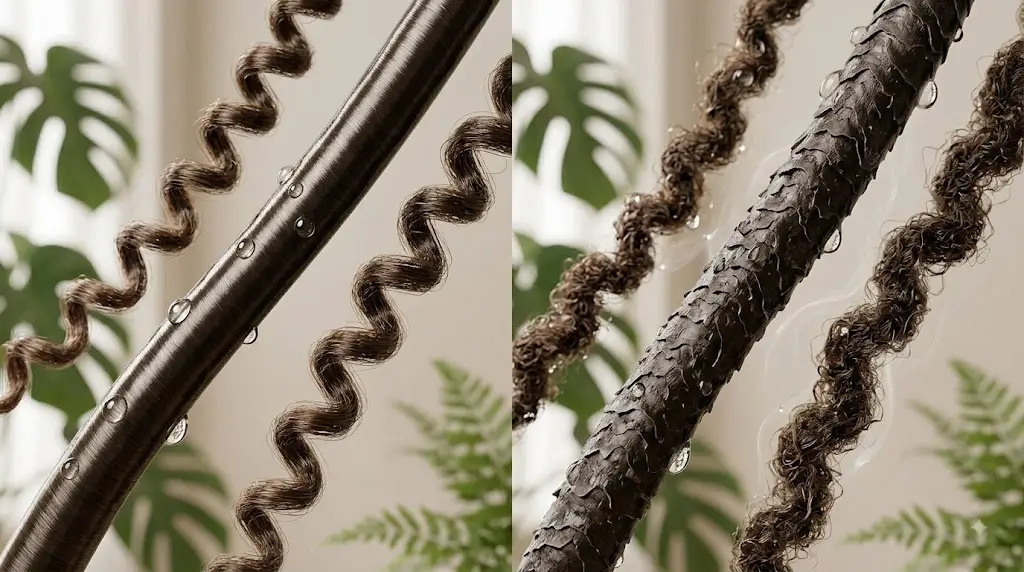
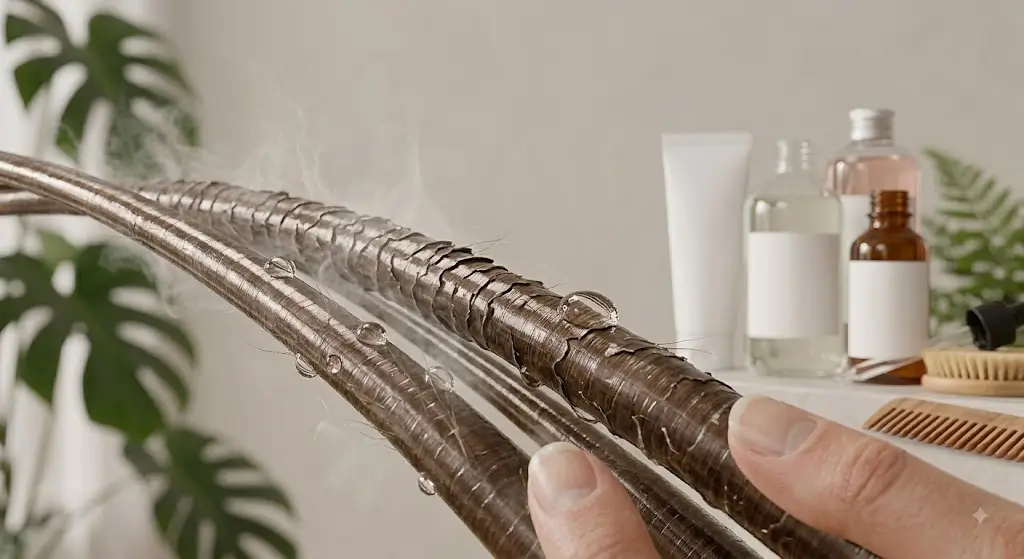
The hair cuticle—the outer layer of the hair shaft—plays an important role in this process. The condition of the cuticle can influence how water and hair-care products interact with the hair.
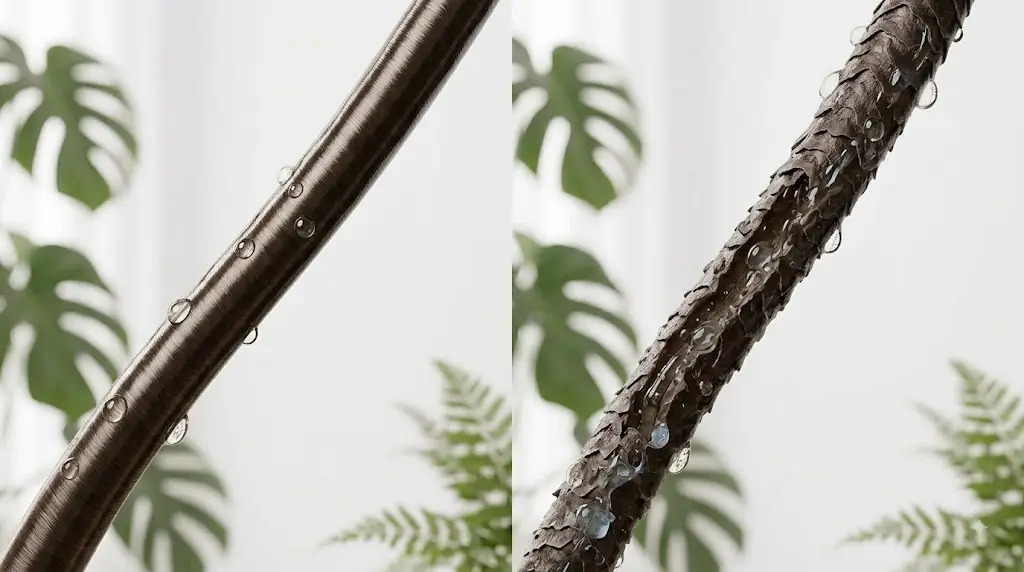
Hair porosity is generally described in three categories:
- Low porosity: moisture may take longer to enter the hair.
- Medium porosity: moisture absorption and retention are often relatively balanced.
- High porosity: moisture can enter readily but may also escape more easily.
However, these categories should be treated as useful descriptions rather than rigid labels. Hair can behave differently depending on its condition, products, environment, heat exposure, chemical treatments, and everyday handling.
Low Porosity vs High Porosity Hair at a Glance
The easiest way to understand the difference is to look at how each type tends to behave around water and products.
| Feature | Low Porosity Hair | High Porosity Hair |
|---|---|---|
| Getting fully wet | May take longer | Often happens more quickly |
| Moisture entry | Can be slower | Can happen readily |
| Moisture retention | Often relatively good once moisturized | Can be more challenging |
| Product behaviour | Products may sit on the surface | Products may absorb quickly |
| Product buildup | Can be more noticeable | May be less of a surface-buildup issue |
| Drying | May take longer | May dry more quickly |
| Common concern | Getting moisture and products to distribute | Keeping moisture in the hair |
These are general patterns, not rules that every person with a particular porosity will experience.
How Low Porosity Hair Usually Behaves
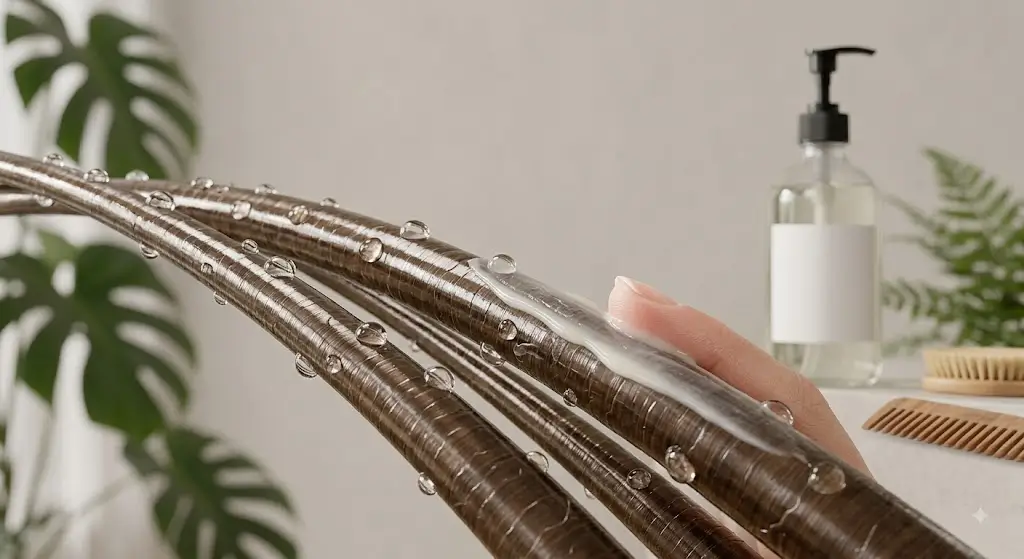
Low porosity hair is often described as hair that does not absorb moisture as readily as higher-porosity hair.
One of the easiest observations is what happens when you wash your hair. It may take a little longer for water to fully saturate the strands.
You may also notice that some conditioners, creams, oils, or styling products seem to remain on the outside of the hair rather than disappearing into the strands.
This can create another common issue: product buildup.
When several layers of products accumulate, the hair may feel coated, heavy, dull, or difficult to moisturize effectively. However, these signs are not exclusive to low porosity hair, so they should not be used as a diagnosis on their own.
Does low porosity mean healthy hair?
Not necessarily.
Low porosity does not automatically mean that hair is healthier, stronger, or undamaged. Porosity describes moisture behaviour; overall hair condition involves many other factors.
For example, hair can have relatively low porosity while still experiencing dryness, breakage, heat damage, or mechanical damage.
Understanding the differences between porosity types is useful, but knowing how to care for low porosity hair is the next step toward building a practical routine.
How High Porosity Hair Usually Behaves
High porosity hair tends to allow water and moisture to enter more readily.
This can sound like an advantage—and in some situations it can make moisturizing easier—but there is another side to the equation.
Hair that takes in moisture readily may also have more difficulty retaining that moisture.
You may notice that your hair feels moisturized after washing or conditioning but becomes dry again relatively quickly. Frizz, tangling, roughness, and a tendency to lose moisture can also be noticeable in some high-porosity hair.
High porosity can occur naturally, but hair’s porosity behaviour can also be affected by factors such as repeated chemical processing, heat exposure, and physical wear.
Does high porosity always mean damaged hair?
No.
This is an important distinction.
High porosity hair is not automatically damaged hair. Some people naturally have hair that behaves as high porosity.
At the same time, repeated bleaching, colouring, chemical treatments, heat styling, and mechanical stress can affect the hair cuticle and contribute to increased porosity.
So high porosity and hair damage are related concepts, but they are not the same thing.
If your hair has also experienced significant heat or chemical damage, our Hair Care Routine for Damaged Hair offers additional practical guidance.
7 Key Differences Between Low and High Porosity Hair
Understanding these differences can help you recognize patterns in your own hair without relying on a single test.
1. How Quickly Hair Gets Wet
One of the most noticeable differences can be how quickly your hair becomes fully saturated with water.
Low porosity
Water may take longer to spread through the hair, particularly when the hair is densely packed or has a buildup of products.
You may find yourself spending more time making sure the hair is completely wet before shampooing or conditioning.
High porosity
Water can often enter the hair more readily.
Hair may become saturated relatively quickly during washing.
However, getting wet quickly does not necessarily mean the hair will stay moisturized for longer.
2. Moisture Retention
Moisture absorption and moisture retention are not the same thing.
This is one of the most important ideas to understand about hair porosity.
Low porosity
Once moisture has entered the hair, it may remain relatively well retained.
The challenge can be getting the moisture in and distributing products effectively.
High porosity
Moisture may enter easily, but retaining it can be more difficult.
This is why high-porosity hair may benefit from routines focused not only on adding moisture but also on helping the hair retain it.
3. How Hair Products Behave
Your hair’s reaction to products can provide useful clues.
Low porosity
You may notice that:
- creams seem to sit on the hair
- heavy oils can make the hair feel coated
- multiple products can lead to buildup
- lightweight formulas may feel easier to use
This does not mean every low-porosity hair type needs lightweight products exclusively. Your hair’s density, texture, condition, and styling goals still matter.
High porosity
Products may seem to disappear into the hair quickly.
You may also find that your hair needs conditioning more regularly because the moisturized feeling does not last as long.
4. Drying Time
Drying time can provide another useful clue.
Low porosity
Low-porosity hair may take longer to dry because water can remain on or within the hair for longer.
Hair density also makes a significant difference. Thick, dense hair can take a long time to dry regardless of porosity.
High porosity
High-porosity hair may dry more quickly because moisture can move in and out of the hair more readily.
Again, this is not a perfect test. Hair length, density, climate, airflow, and styling method all affect drying time.
5. Product Buildup
Product buildup can be particularly frustrating when products repeatedly remain on the surface of the hair.
Low porosity
Because products may not distribute or absorb as easily, applying too many layers can leave hair feeling:
- heavy
- coated
- dull
- greasy
- difficult to moisturize
Using more product is therefore not always the answer.
High porosity
High-porosity hair may have a different challenge. Instead of products simply sitting on the surface, the hair may seem to absorb them quickly and still feel dry later.
This is why product choice should be based on the hair’s actual response rather than porosity labels alone.
6. Response to Humidity
Humidity can affect different hair types in different ways.
High-porosity hair may be particularly prone to changes in moisture balance because the hair can interact readily with environmental moisture.
Frizz and changes in texture may become more noticeable in humid conditions.
Low-porosity hair can also respond to humidity, of course. Porosity is only one factor influencing how hair behaves in different environments.
7. The Main Hair-Care Challenge
Perhaps the simplest way to remember the difference is:
Low porosity:
Getting moisture in and avoiding buildup.
High porosity:
Keeping moisture in and minimizing unnecessary damage.
This is not a strict rule, but it provides a useful starting point when designing a routine.
Which Is Better: Low or High Porosity Hair?
Neither.
Low and high porosity simply describe different patterns of moisture behaviour.
Low porosity hair may be easier to keep moisturized once moisture is properly distributed, but product buildup can become frustrating.
High porosity hair may absorb moisture readily, but retaining that moisture can require more attention.
Instead of asking:
“Which porosity is healthier?”
a better question is:
“What does my hair need based on how it actually behaves?”
That approach is much more useful.
Low Porosity Hair Care Basics
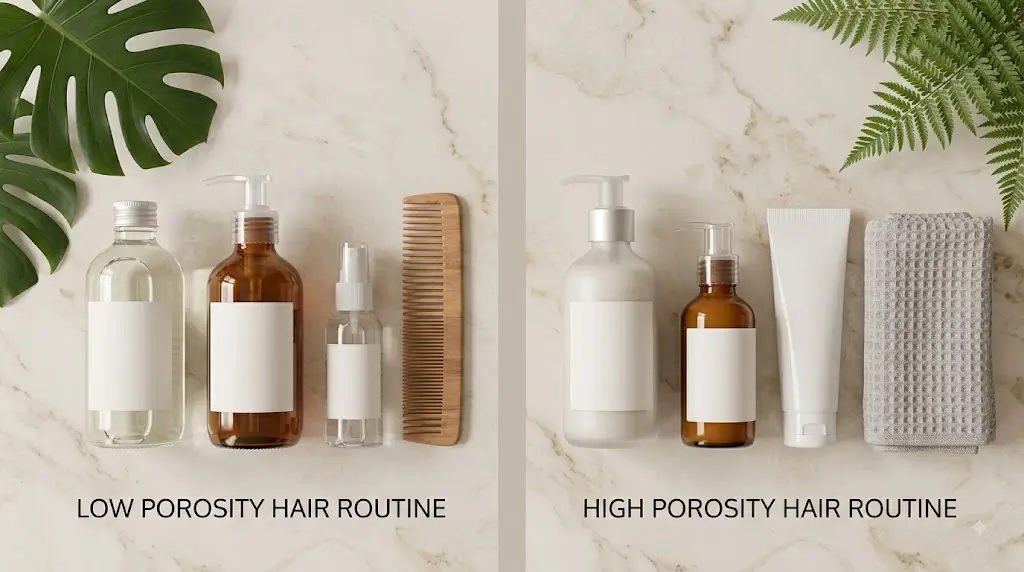
If your hair behaves like low porosity hair, consider keeping your routine simple and observing how your hair responds.
1. Avoid automatically using heavy products
Heavy creams and oils are not necessarily bad, but applying too much can leave low-porosity hair feeling coated.
2. Focus on even product distribution
Make sure conditioner and styling products are distributed through the hair rather than concentrated in one area.
If you are looking for product ideas, our guide to Low porosity hair products covers options worth considering for this hair type.
3. Watch for buildup
If your hair repeatedly feels coated or dull, review how many products you are layering.
4. Don’t confuse dryness with a need for more product
Sometimes adding more product makes the problem worse.
A simpler routine may work better.
5. Consider your hair’s full characteristics
Porosity is only one piece of the puzzle. Hair density, strand thickness, curl pattern, chemical history, and styling habits also matter.
High Porosity Hair Care Basics
High-porosity hair often benefits from a different approach.
1. Prioritize conditioning
Regular conditioning can help improve the feel and manageability of hair that tends to lose moisture quickly.
2. Consider leave-in conditioning
A suitable leave-in conditioner may help maintain softness between wash days.
3. Reduce unnecessary heat and chemical stress
Repeated high heat and chemical processing can contribute to changes in hair condition.
Protecting the hair from avoidable stress is therefore important.
For a more detailed routine, see our guide to a high porosity hair care routine
4. Be gentle when the hair is wet
Wet hair can be more vulnerable to mechanical damage. Avoid aggressive brushing, pulling, or rough towel drying.
5. Focus on moisture retention
For high-porosity hair, the routine should not only add moisture but also help the hair maintain a comfortable, conditioned feel.
Can Hair Porosity Change?
Hair porosity is not necessarily a permanent, unchanging characteristic.
The condition of the hair cuticle can be affected by chemical processing, heat, environmental exposure, and mechanical wear.
For example, hair that has been repeatedly bleached may behave differently from untreated hair.
This is one reason it is better to periodically reassess how your hair behaves rather than choosing products based on a porosity label forever.
Your hair can also have different needs at different times.
A routine that worked well when your hair was untreated may not work as well after colouring, bleaching, frequent heat styling, or a significant change in length.
Don’t Rely on One Hair Porosity Test
There are many online methods for estimating hair porosity, including simple home tests.
However, no single test should be treated as a definitive diagnosis of your hair’s condition.
Instead, look at several observations together:
- How quickly does your hair become completely wet?
- Does conditioner seem to distribute easily?
- Does your hair feel coated after using products?
- How quickly does it dry?
- Does it stay moisturized between washes?
- Does it become dry again soon after conditioning?
- How does it respond to different product textures?
Looking at these patterns over time can give you more useful information than relying on one isolated test.
If you want to explore your hair porosity further, our Hair Porosity Test guide can help you understand the common signs to look for.
How to Work Out Whether Your Hair Is Low or High Porosity
If you’re unsure, start by observing your normal wash routine.
Your hair may behave more like low porosity hair if:
- it takes longer to become fully wet
- products often seem to sit on the surface
- buildup happens easily
- heavy products can make it feel weighed down
- moisture seems difficult to distribute
Your hair may behave more like high porosity hair if:
- it becomes wet quickly
- moisture seems to disappear quickly
- hair often feels dry again soon after conditioning
- frizz or roughness is common
- your hair has experienced substantial chemical or heat processing
These are clues, not a diagnosis.
For a broader approach to building a consistent routine, explore our Complete Hair Care Guide.
Recommended sources:
Final Takeaway
The biggest difference between low and high porosity hair comes down to how your hair interacts with moisture.
Low porosity hair may need help allowing moisture and products to distribute effectively, while high porosity hair may need more attention to moisture retention and protection.
But porosity should never be viewed in isolation.
Your hair’s density, strand thickness, curl pattern, chemical history, heat exposure, climate, and daily routine all influence the way it behaves.
Instead of following a rigid “low porosity” or “high porosity” rule, use porosity as one useful piece of information—and let your hair’s actual response guide your routine.
FAQ
Is low porosity hair better than high porosity hair?
No. Neither is automatically better. They simply tend to behave differently when interacting with water and hair-care products.
Does high porosity mean damaged hair?
Not necessarily. Hair can naturally behave as high porosity, although chemical processing, heat, and physical wear can contribute to increased porosity.
Why does low porosity hair get buildup easily?
Products may remain more noticeably on the hair’s surface, particularly when several layers of product are applied.
Why does high porosity hair get dry quickly?
High-porosity hair may absorb moisture readily but can also lose moisture more easily, making moisture retention an important part of the routine.
Can hair porosity change?
Hair behaviour can change as the condition of the cuticle changes through chemical processing, heat, environmental exposure, and mechanical wear.
Can I have different porosity levels on the same head?
Yes. Hair condition can vary across different areas, especially when some sections have experienced more chemical processing, heat, or wear than others.
Should I choose products based only on porosity?
No. Porosity is useful, but hair density, strand thickness, texture, condition, styling habits, and personal preferences also matter.