Introduction
Choosing the right hair care routine starts with understanding your hair type. Different hair types have different characteristics, and what works well for one person may not be suitable for another.
Knowing whether your hair is straight, wavy, curly, or coily can help you choose products, washing routines, and styling techniques that match your individual needs.
In this beginner-friendly guide, you’ll learn how to identify your hair type, understand its characteristics, and make informed hair care choices based on your natural hair texture.
If you’re new to hair care, our Complete Hair Care Guide explains the daily, weekly, and monthly habits that can help you build a simple and effective hair care routine.
Why Knowing Your Hair Type Matters
Many hair care products are designed for specific hair types.
Understanding your natural hair texture may help you:
- Choose suitable shampoos and conditioners.
- Build an appropriate washing routine.
- Reduce unnecessary hair damage.
- Improve hair manageability.
- Select styling products more effectively.
- Avoid buying products that may not suit your hair.
There is no “best” hair type. Each hair type has its own characteristics and may benefit from different care routines.
Once you’ve identified your hair type, the next step is choosing an appropriate washing routine. Read our guide on how often you should wash your hair to build a routine that matches your hair’s needs.
The Four Main Hair Types
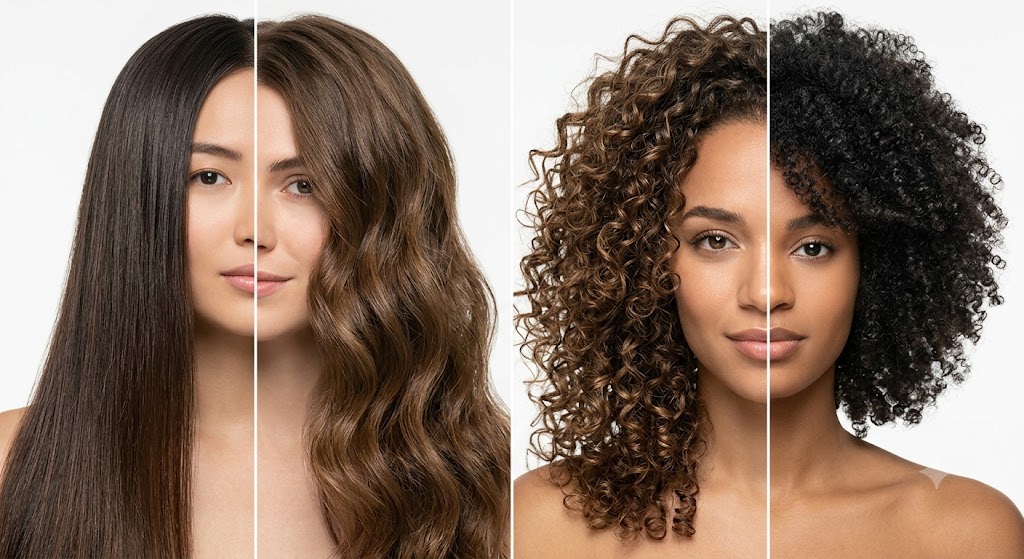
Hair is commonly grouped into four main categories.
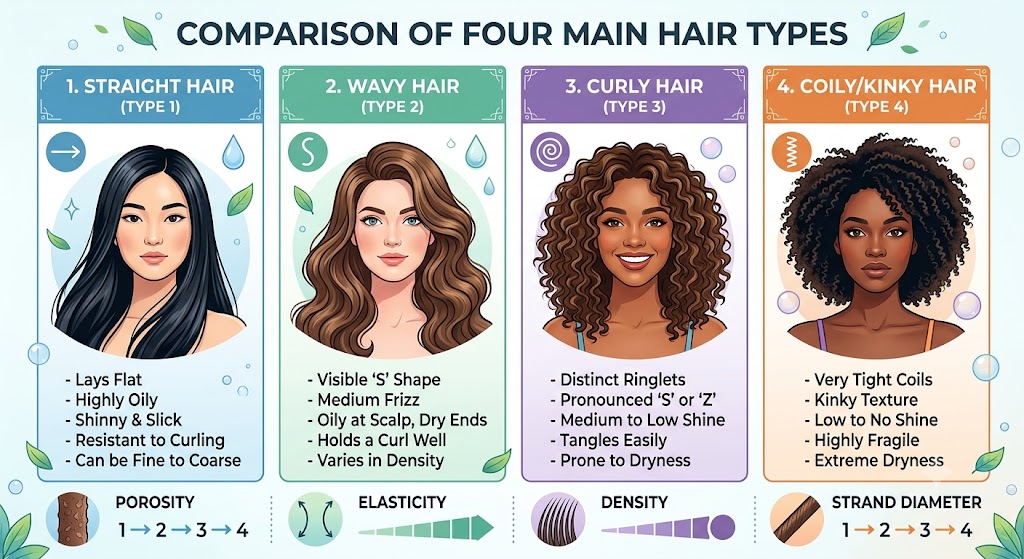
These categories describe the natural shape of the hair strand.
| Hair Type | Natural Shape | General Characteristics |
|---|---|---|
| Straight | Straight | Smooth appearance, oil may spread more easily |
| Wavy | Loose S-shape | Natural waves with moderate volume |
| Curly | Defined curls | More curl definition and volume |
| Coily | Tight coils | Tight curls that often require gentle handling |
These categories provide a general framework. Individual hair characteristics can vary from person to person.
Along with texture and pattern, Hair porosity is another characteristic worth considering when you are trying to understand your hair’s needs.
How to Identify Your Hair Type at Home
Learning how to identify your hair type is one of the easiest ways to build a suitable hair care routine.
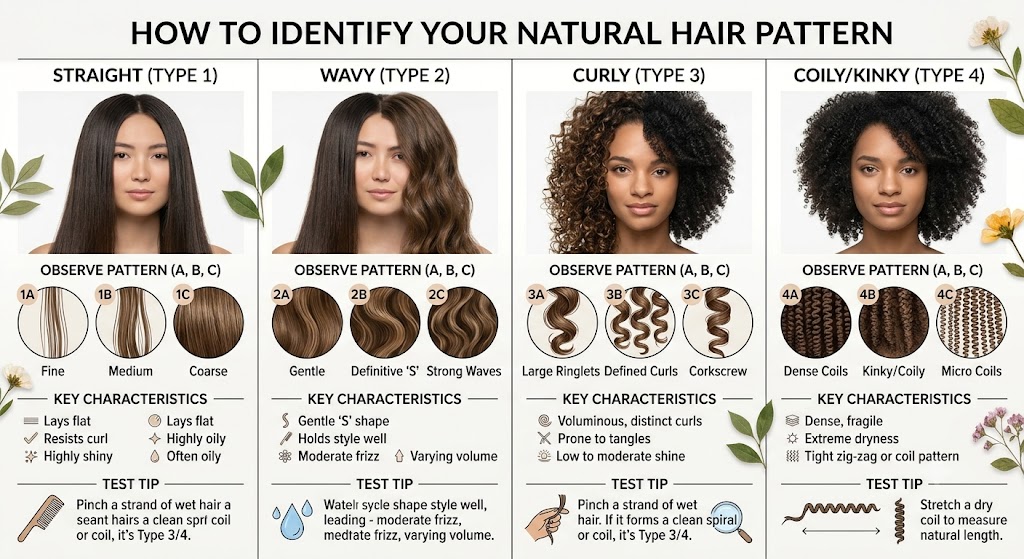
If you’re wondering how to identify your hair type correctly, observing your natural hair pattern is a good starting point.
You don’t need special equipment to identify your hair type.
Try this simple method:
Step 1
Wash your hair using your usual shampoo and conditioner.
Avoid applying styling products afterward.
Step 2
Allow your hair to air dry naturally whenever practical.
Avoid blow-drying or straightening during this test.
Step 3
Observe your natural hair pattern.
Ask yourself:
- Does your hair dry completely straight?
- Does it form loose waves?
- Does it develop defined curls?
- Does it naturally form tight coils?
Your natural drying pattern often provides useful clues about your hair type.
Other Factors That Influence Hair Care
Hair type is only one part of your hair care routine.
You should also consider:
- Hair thickness
- Hair density
- Scalp condition
- Climate
- Daily activities
- Chemical treatments (such as coloring or perming)
All of these factors can influence the products and routine that work best for you.
Quick Tip
Don’t compare your hair with someone else’s.
Even people within the same hair type category may have different hair thickness, density, and scalp conditions.
The goal is to understand your own hair rather than achieving someone else’s hair texture.
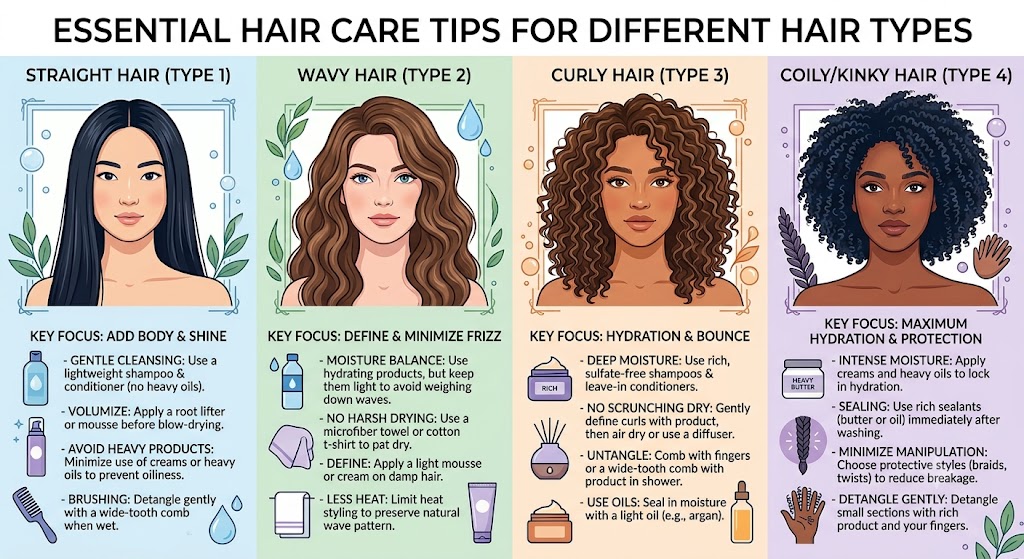
Type 1: Straight Hair
Straight hair naturally grows without noticeable waves or curls.
Because the hair strand is straight, natural oils produced by the scalp may travel more easily from the roots to the ends. As a result, some people with straight hair notice that their hair becomes oily sooner than other hair types.
However, individual experiences vary depending on scalp condition, climate, lifestyle, and hair care habits.
Common Characteristics
- Smooth appearance
- Natural shine
- Easier to comb
- May become oily more quickly
- Can sometimes appear flat with limited natural volume
Hair Care Tips for Straight Hair
If you have straight hair, consider these general care tips:
- Choose products suitable for your hair type.
- Wash your hair according to your scalp’s needs.
- Avoid applying heavy conditioner directly to the scalp unless directed by the product instructions.
- Rinse shampoo and conditioner thoroughly.
- Minimize excessive heat styling whenever possible.
A simple and consistent routine often works well for straight hair.
Common Challenges
People with straight hair may experience:
- Oily scalp
- Product buildup
- Flat-looking hair
- Greasy roots between washes
These concerns vary from person to person and are not experienced by everyone.
Mistakes to Avoid
Avoid:
- Using excessive amounts of styling products.
- Washing more frequently than necessary if it causes dryness.
- Applying oils heavily to the scalp unless appropriate for your routine.
Type 2: Wavy Hair
Wavy hair falls between straight and curly hair.
It usually forms a natural “S” shape and often has more volume than straight hair while remaining easier to manage than tighter curl patterns.
Some people notice that humidity affects the appearance of wavy hair more noticeably.
Common Characteristics
- Loose natural waves
- Moderate volume
- May become frizzy in humid weather
- Often responds well to lightweight moisturizing products
- Can sometimes lose wave definition after brushing
Hair Care Tips for Wavy Hair
General care suggestions include:
- Use products suitable for wavy hair.
- Avoid over-brushing after the hair has dried.
- Apply conditioner mainly to the mid-lengths and ends.
- Allow hair to air dry when practical.
- Use a microfiber towel or soft cotton T-shirt to gently remove excess water.
These habits may help improve manageability for some people.
Common Challenges
People with wavy hair sometimes experience:
- Frizz
- Uneven wave definition
- Dry ends
- Product buildup
The right routine varies depending on individual hair characteristics.
Once you understand your hair characteristics, our guide to a hair care routine for fine hair can help if your individual strands are naturally fine.
Mistakes to Avoid
Try to avoid:
- Using very heavy styling products if they weigh your hair down.
- Brushing dry waves aggressively.
- Excessive heat styling.
- Frequently touching your hair after styling, which may increase frizz for some individuals.
Straight Hair vs Wavy Hair
| Feature | Straight Hair | Wavy Hair |
|---|---|---|
| Natural Shape | Straight | Loose S-shaped waves |
| Volume | Usually lower | Moderate |
| Oil Distribution | Oil may spread more easily | Moderate |
| Frizz | Usually less | May increase in humid weather |
| Styling | Easier to straighten | Holds texture more easily |
This comparison provides a general overview. Individual hair characteristics may vary.
Quick Tip
If you’re unsure whether your hair is straight or wavy, allow it to air dry without styling products after washing.
Your natural drying pattern often provides a better indication of your hair type than how your hair looks after blow-drying or heat styling.
Type 3: Curly Hair
Curly hair naturally forms well-defined curls or ringlets. Compared with straight or wavy hair, curly hair often requires additional moisture because natural oils may not travel as easily from the scalp to the ends.
Each person’s curls are unique. Curl size, density, and thickness can vary widely.
Common Characteristics
- Well-defined curls or ringlets
- Natural volume
- May feel dry more easily
- Can become frizzy in humid conditions
- Often requires gentle detangling
Hair Care Tips for Curly Hair
General care suggestions include:
- Use products suitable for curly hair.
- Detangle gently while the hair is damp if appropriate.
- Apply conditioner mainly to the mid-lengths and ends.
- Avoid excessive heat styling whenever possible.
- Sleep on a smooth pillowcase, such as satin or silk, if it suits your preferences.
Consistency is often more beneficial than frequently changing products.
Common Challenges
People with curly hair may experience:
- Dryness
- Frizz
- Tangles
- Breakage during brushing
- Loss of curl definition
These experiences vary depending on individual hair characteristics and routines.
Mistakes to Avoid
Avoid:
- Brushing dry curls aggressively.
- Using excessive heat without following product or device instructions.
- Skipping conditioner if your hair benefits from added moisture.
- Frequently changing multiple products at the same time.
Type 4: Coily Hair
Coily hair forms tight curls or coils and is often delicate.
Because natural oils may take longer to travel along tightly coiled strands, some people find that coily hair benefits from routines that help maintain moisture while minimizing unnecessary breakage.
Every individual’s hair is different, and routines should be adjusted according to personal needs.
Common Characteristics
- Tight coils
- High natural volume
- May feel dry more easily
- Shrinkage is common
- Often requires gentle handling
Hair Care Tips for Coily Hair
General suggestions include:
- Cleanse according to your hair and scalp needs.
- Use products suitable for your hair type.
- Detangle gently and patiently.
- Reduce unnecessary tension from tight hairstyles.
- Protect your hair during sleep if appropriate for your routine.
Common Challenges
Some people with coily hair may experience:
- Dryness
- Breakage
- Tangles
- Shrinkage
- Difficulty retaining moisture
Individual experiences vary considerably.
Mistakes to Avoid
Avoid:
- Pulling tightly on knots.
- Frequent tight hairstyles without giving your hair time to rest.
- Excessive heat styling.
- Skipping regular scalp care.
Hair Type vs Hair Thickness
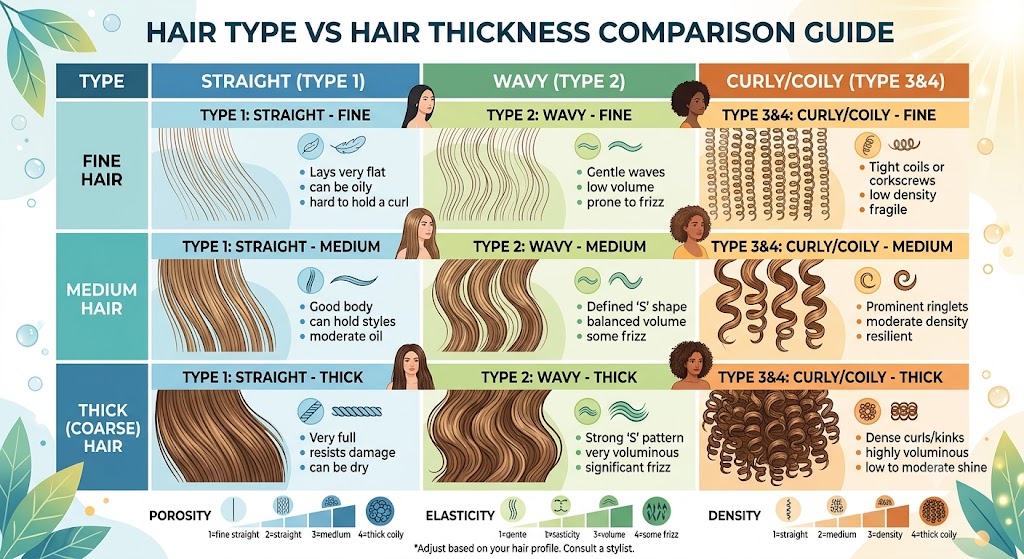
Hair type and hair thickness are different.
Many people confuse these two terms.
| Hair Type | Hair Thickness |
|---|---|
| Describes the natural shape of your hair | Describes the width of each individual hair strand |
| Straight, Wavy, Curly, or Coily | Fine, Medium, or Thick |
For example:
- Someone may have curly, fine hair.
- Another person may have straight, thick hair.
- Both characteristics are important when choosing hair care products.
Frequently Asked Questions (FAQ)
Can my hair type change over time?
Yes.
Hair texture may change due to factors such as age, hormonal changes, certain medical conditions, or chemical treatments. If you notice sudden or significant changes, consult a qualified healthcare professional.
Can I have more than one hair type?
Yes.
Some people have different curl patterns on different parts of the scalp. This is normal.
Does cutting my hair change its type?
No.
Cutting your hair changes its length, not its natural hair type or texture.
Is one hair type healthier than another?
No.
There is no “best” hair type.
Each hair type has unique characteristics and benefits from an appropriate care routine.
When to See a Doctor
Consult a qualified dermatologist or healthcare professional if you experience:
- Sudden or severe hair loss.
- Persistent scalp irritation.
- Painful scalp swelling.
- Bleeding or discharge from the scalp.
- Significant changes in hair texture without an obvious reason.
- Hair loss associated with other concerning health symptoms.
Early evaluation may help identify the underlying cause.
Trusted Resources
For readers who would like to explore additional evidence-based information about hair and scalp care, the following trusted organizations provide helpful educational resources:
American Academy of Dermatology (AAD): Hair and Scalp Care
NHS (National Health Service): Hair Loss
Mayo Clinic: Healthy Hair Care
Medical Disclaimer
This article is intended for educational and informational purposes only. It is not a substitute for professional medical advice, diagnosis, or treatment. Hair type and hair care needs vary from person to person. If you have persistent scalp concerns, unusual hair loss, or questions about treatments suitable for your individual needs, consult a qualified healthcare professional or dermatologist. Never ignore or delay seeking professional medical advice because of information you have read online.
Even after identifying your hair type, everyday habits can affect your hair’s condition. Explore our guide on common hair care mistakes to learn which routines are worth avoiding.
Conclusion
Understanding your hair type is one of the first steps toward building a simple and effective hair care routine. Whether your hair is straight, wavy, curly, or coily, choosing products and habits that match your natural hair characteristics may help improve manageability and overall hair appearance.
Remember that hair type is only one part of healthy hair care. Factors such as scalp condition, hair thickness, lifestyle, climate, and personal preferences also play an important role. Instead of following every trend, take time to understand your own hair and make gradual adjustments that suit your individual needs.
If you notice sudden changes in your hair or persistent scalp concerns, seek advice from a qualified healthcare professional or dermatologist.
Quick Hair Type Checklist
✅ Straight Hair
- Naturally smooth
- Oil may spread more easily
- Often appears shiny
- May have less natural volume
✅ Wavy Hair
- Loose S-shaped waves
- Moderate volume
- Can become frizzy in humid weather
- Often benefits from lightweight products
✅ Curly Hair
- Defined curls or ringlets
- Natural volume
- May require additional moisture
- Gentle detangling is often helpful
✅ Coily Hair
- Tight curls or coils
- High volume
- Shrinkage is common
- Often benefits from gentle handling and moisture-focused care
Key Takeaways
✔ Understanding your hair type helps you choose a suitable hair care routine.
✔ There is no “best” hair type.
✔ Hair type and hair thickness are different.
✔ Individual routines should be based on your hair’s needs rather than trends.
✔ Consistency is often more beneficial than frequently changing products.
✔ Consult a qualified healthcare professional if you experience unusual hair or scalp changes.