
INTRODUCTION
How to Build a Simple Weekly Hair Care Schedule
A good hair care routine does not have to involve a long list of products or complicated steps.
For many people, the hardest part is simply knowing what to do and when to do it.
Should you wash your hair today?
Do you need conditioner every time?
When should you focus on your scalp?
How often should you give your hair a little extra care?
A simple weekly hair care routine can make these decisions easier.
Instead of trying to follow someone else’s exact schedule, you can build a routine around your hair type, scalp needs, washing frequency, lifestyle, and the condition of your hair.
For example, someone with an oily scalp may need a different routine from someone with dry or curly hair. Someone who exercises regularly may also need to adjust their routine based on sweat and activity.
The goal is not to create a perfect seven-day timetable that never changes.
The goal is to create a flexible weekly framework that helps you take consistent care of your scalp and hair without making hair care feel like a chore.
In this guide, we’ll look at how to organise everyday, weekly, and occasional hair-care habits into a simple routine that can be adjusted to suit your individual needs.
Table of Contents
Start With Your Hair and Scalp Needs
Before creating a weekly schedule, take a moment to understand what your hair actually needs.
A useful routine starts with observation rather than a shopping list.
Consider Your Scalp
Ask yourself:
- Does my scalp become oily quickly?
- Does it feel dry or uncomfortable?
- Do I regularly sweat during exercise?
- Do I notice product buildup?
- Does my scalp generally feel comfortable between washes?
These observations can help you decide how often cleansing should appear in your weekly routine.
There is no requirement for everyone to wash their hair on the same days or at the same frequency.
If your hair tends to absorb moisture quickly but lose it just as quickly, you may want to adapt your weekly routine with these High-porosity hair care tips.
Consider Your Hair Type
Your hair texture also matters.
Straight, wavy, curly, coily, thick, fine, dry, and chemically treated hair can all respond differently to everyday care.
The American Academy of Dermatology notes that healthy hair care begins with understanding your hair type and adjusting care accordingly.
That means your weekly routine should be personalised rather than copied.
If you are still deciding where to begin, our guide to a Hair Care Routine for Your Hair Type can help you build a routine around your individual needs.
Consider Your Lifestyle
Your weekly schedule may also need to change depending on what you do.
For example:
Regular exercise → more attention to sweat and scalp freshness
Swimming → additional hair-care considerations
Frequent heat styling → greater focus on gentle handling
Colour-treated hair → extra attention to dryness and damage
Busy work or travel schedule → a simpler routine may be easier to maintain
A good routine should fit your actual life.
If a routine is so complicated that you cannot maintain it consistently, it probably needs simplifying.
The Three Levels of a Simple Hair Care Routine
One of the easiest ways to organise your weekly hair care is to divide it into three levels:
1. Everyday Habits
These are small actions that support your hair throughout the week.
Examples include:
- Handling hair gently
- Avoiding unnecessary pulling
- Keeping hairstyles comfortable
- Protecting hair from excessive friction
- Paying attention to changes in your scalp or hair
These habits do not need to take much time.
2. Regular Washing and Conditioning
Your cleansing routine should be based primarily on your scalp and hair needs.
As we discussed in our previous guide, there is no universal number of washes that works for everyone.
If your scalp becomes oily quickly, you may need more frequent washing. If your hair is dry, curly, coily, or textured, your routine may look different.
Your weekly routine may also need to reflect your hair’s porosity, so explore our guide on how to care for low porosity hair for a more targeted approach.
3. Occasional Extra Care
Some people may benefit from occasional additional care, depending on their hair.
This might include:
- A conditioning treatment
- A gentle detangling session
- Reviewing product buildup
- Checking whether current products still suit your hair
- Assessing whether frequent heat styling is making hair feel dry
The important word is occasional.
A weekly routine does not need to turn every hair-care activity into a mandatory treatment.
A Simple Weekly Hair Care Schedule
A weekly hair care routine does not need to mean performing a completely different treatment every day.
Instead, think of your week as a flexible framework.
Your washing days, conditioning habits, styling practices, and extra-care steps can move around depending on your scalp, hair type, work schedule, exercise routine, and personal preferences.
As part of your regular hair-care planning, use our Scalp Sun Protection Guide to prepare for days when you expect prolonged outdoor exposure.
A Practical Weekly Framework
| Routine | What to Focus On |
|---|---|
| Daily | Gentle handling, comfortable hairstyles, and noticing changes in your scalp or hair |
| Wash days | Cleanse the scalp according to your individual needs and condition where appropriate |
| Between washes | Keep handling gentle and avoid unnecessary buildup from excessive styling products |
| Once during the week | Take a few minutes to review how your hair and scalp are responding |
| Occasionally | Add extra conditioning or other suitable care when your hair actually needs it |
This framework is intentionally flexible.
You do not need to force every activity into a particular weekday.
Simple Daily Hair Care Habits
The foundation of a weekly hair care routine is what you do consistently throughout the week.
Fortunately, these habits do not need to be complicated.
Handle Hair Gently
Avoid unnecessary pulling, tugging, or rough handling.
When brushing or detangling, work carefully rather than forcing through knots.
Avoid Constantly Tight Hairstyles
If you regularly wear your hair tied back, consider whether the style feels comfortable.
Repeated tension from very tight hairstyles can place stress on the hair.
Choosing comfortable styles and changing them when appropriate can make everyday hair care easier.
Be Mindful of Heat Styling
If you regularly use hair dryers, straighteners, curling tools, or other heated styling equipment, consider how often you use them and how your hair responds.
If your hair increasingly feels dry or fragile, reviewing your heat-styling habits may be worthwhile.
The American Academy of Dermatology recommends taking steps to reduce practices that can contribute to hair damage, including excessive heat.
Build Your Week Around Wash Days
Rather than deciding that everyone should wash their hair on specific days, start by identifying how often your scalp actually needs cleansing.
For example, someone with a quickly oily scalp may have more wash days than someone with dry or textured hair.
Your weekly routine might therefore look something like this:
Your weekly routine may also need to reflect your strand thickness, so see our guide to a Hair care routine for fine hair for a more targeted approach.
Wash day
→ Cleanse the scalp
→ Condition according to your hair’s needs
→ Detangle gently
→ Allow hair to dry appropriately
Between wash days
→ Keep styling gentle
→ Avoid unnecessary manipulation
→ Monitor scalp comfort
→ Adjust products if buildup becomes noticeable
Next wash day
→ Reassess your scalp and hair
→ Adjust the routine if necessary
This approach is more useful than treating a seven-day schedule as a rigid rule.
For a closer look at choosing your washing frequency, see our guide on How Often Should You Wash Your Hair?
What to Do on a Low-Maintenance Hair Day
Not every day needs a special hair treatment.
Some days, the best thing you can do is simply leave your hair alone.
A low-maintenance day might involve:
- Avoiding unnecessary brushing
- Choosing a comfortable hairstyle
- Limiting heat styling
- Not adding unnecessary products
- Protecting hair from excessive friction
- Checking whether your scalp feels comfortable
This is especially useful for people who sometimes feel overwhelmed by complicated hair-care routines.
More products do not automatically mean better hair care.
Consistency and appropriate habits matter more than having a long checklist.
A WEEKLY HAIR CARE CHECK-IN
Give Your Hair a Weekly Check-In
Once a week, take a few minutes to consider how your current routine is working.
Ask yourself:
Scalp
- Does my scalp feel comfortable?
- Is it becoming oily sooner than usual?
- Have I noticed unusual itching, flaking, or irritation?
Hair
- Does my hair feel manageable?
- Are the lengths unusually dry?
- Is my hair becoming more tangled?
- Does it feel different after washing?
Routine
- Am I using more styling products than usual?
- Have I been using heat frequently?
- Have my exercise or outdoor activities changed?
- Is my current routine realistic enough to maintain?
These questions can help you notice when your routine needs a small adjustment.
You do not need to change everything at once.
WHEN YOUR ROUTINE NEEDS TO CHANGE
When Should You Adjust Your Weekly Hair Care Routine?
Your hair care schedule does not have to remain identical throughout the year.
You may need to adjust it when your circumstances change.
For example:
More exercise
→ You may need to pay more attention to sweat and scalp freshness.
A change in weather
→ Your hair may feel different in very dry, humid, or hot conditions.
More styling
→ You may need to reconsider product buildup and heat exposure.
Hair colouring or chemical treatments
→ Your hair may require more careful handling.
A change in scalp behaviour
→ Your cleansing routine may need to be reassessed.
A flexible routine is therefore more practical than a schedule that you follow regardless of what your hair is telling you.
HAIR CARE ROUTINE BY HAIR TYPE
Your Weekly Routine Should Match Your Hair Type
There is no single weekly hair care schedule that suits every hair type.
A routine that works well for straight hair may not feel right for curly or textured hair. Similarly, someone with an oily scalp may need a different cleansing pattern from someone whose hair tends to feel dry.
Use the following as a flexible starting point, rather than a strict timetable.
If your scalp becomes oily quickly, our Hair Care Routine for Oily Hair guide offers more focused everyday care ideas.
Straight Hair
Straight hair can sometimes show oiliness more quickly, particularly when the scalp produces more natural oil.

Your routine can focus on:
- Cleansing according to scalp oiliness
- Keeping styling products under control
- Conditioning where needed
- Avoiding unnecessary heat exposure
- Gentle brushing and handling
If your scalp becomes oily quickly, your wash days may naturally be more frequent.
For a more detailed routine, readers can explore our Hair Care Routine for Your Hair Type guide.
Wavy Hair
Wavy hair can benefit from a balance between cleansing and maintaining its natural texture.
A practical routine can include:
- Washing according to scalp needs
- Conditioning the lengths
- Gentle detangling
- Avoiding excessive brushing when it disrupts the natural wave pattern
- Limiting unnecessary heat styling
Your routine may change depending on weather, activity, styling products, and how your scalp feels.
Curly Hair
Curly hair often benefits from a more personalised approach.
Instead of copying a routine designed for straight hair, pay attention to:
- Scalp cleanliness
- Moisture needs
- Gentle detangling
- Conditioning
- Heat exposure
- How frequently your curls actually need cleansing
For readers looking for more detailed texture-specific guidance, link this section naturally to the existing Hair Care Routine for Curly Hair article.
Coily or Textured Hair
Coily and highly textured hair can require particularly careful handling.
A weekly routine can focus on:
- Gentle cleansing
- Appropriate conditioning
- Careful detangling
- Reducing unnecessary manipulation
- Protecting hair from excessive tension
- Adjusting the routine according to scalp comfort
Avoid assuming that a routine designed for another hair type will automatically work for highly textured hair.
IF YOU HAVE AN OILY SCALP
Adjust Your Routine for an Oily Scalp
If your scalp becomes oily quickly, cleansing may naturally play a larger role in your weekly routine.
Pay attention to:
- Oil appearing at the roots
- Sweat after exercise
- Product buildup
- Hair becoming weighed down
- Changes in scalp comfort
The American Academy of Dermatology recommends adjusting shampoo frequency according to how oily or dirty the hair becomes rather than following one universal schedule.
If oily hair is your main concern, readers can continue to our Hair Care Routine for Oily Hair guide for more focused advice.
IF YOUR HAIR IS DRY
Adjust Your Routine for Dry Hair
Dry-feeling hair may need a gentler approach.
Rather than automatically adding more products, first consider whether your current routine includes too much washing, heat styling, brushing, or chemical processing.
Useful habits may include:
- Using a suitable cleansing routine
- Conditioning the lengths
- Handling hair gently
- Limiting excessive heat
- Avoiding unnecessary manipulation
- Paying attention to how your hair responds after washing
If dry hair is your primary concern, our Hair Care Routine for Dry Hair guide can provide additional ideas.
KEEP YOUR WEEKLY ROUTINE SIMPLE
Your Routine Does Not Need to Be Perfect
A weekly hair care routine should make hair care easier, not more stressful.
You do not need seven different treatments for seven different days.
A simple framework can be enough:
Daily:
Gentle handling + comfortable styling
Wash days:
Scalp cleansing + appropriate conditioning
Between washes:
Minimal manipulation + monitor scalp and hair
Once a week:
Review how your routine is working
As needed:
Make small adjustments
This gives you structure without turning hair care into a rigid checklist.
DON’T CHANGE EVERYTHING AT ONCE
Make One Small Change at a Time
If your current routine is not working well, avoid replacing every product and habit simultaneously.
Instead, consider changing one element at a time.
For example, you might first adjust:
- Washing frequency
- Shampoo technique
- Conditioner placement
- Heat styling frequency
- Brushing or detangling habits
Then observe how your hair responds.
This makes it easier to understand which change was actually helpful.
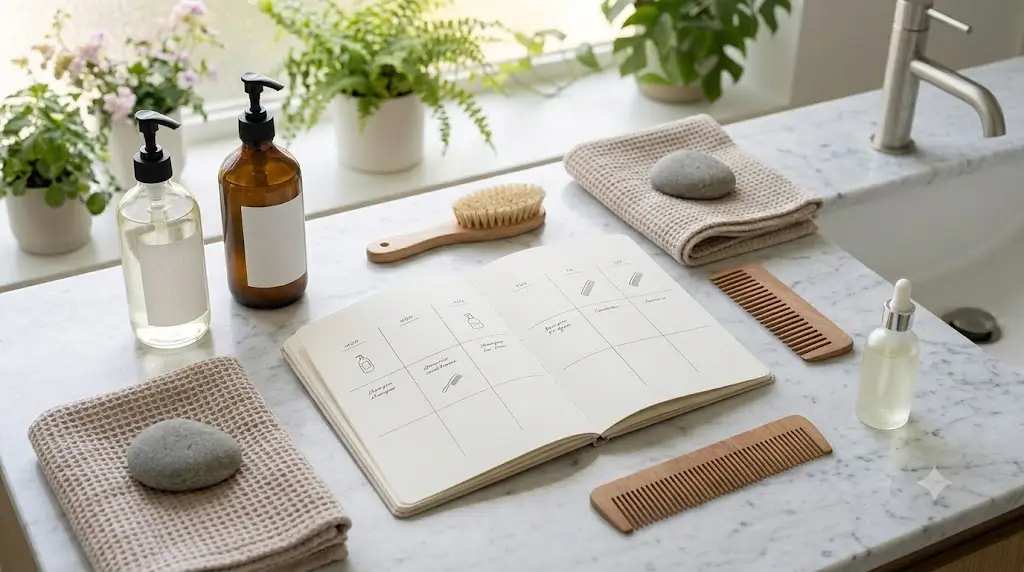
A Simple 7-Day Hair Care Example
A weekly schedule can be useful when it gives you structure without forcing you to follow a routine that does not suit your hair.
The following example is not a universal seven-day rule. Think of it as a framework that you can adjust according to your scalp, hair type, washing frequency, lifestyle, and styling habits.
Day 1 — Assess and Cleanse if Needed
Start the week by checking your scalp.
If it feels oily, sweaty, dirty, or affected by product buildup, this may be an appropriate wash day for you.
If your scalp is still comfortable, there may be no need to wash simply because the week has started.
Day 2 — Keep Handling Gentle
On a non-wash day, focus on simple maintenance.
Avoid unnecessary brushing, pulling, or repeated restyling. If your hair feels comfortable and manageable, you may not need to do anything elaborate.
Day 3 — Check Your Hair’s Condition
Take a quick look at the lengths and ends.
Do they feel comfortable and manageable?
Are they becoming dry or tangled?
Use these observations to decide whether your usual conditioning and styling habits are still working well.
Day 4 — Adjust for Your Lifestyle
Think about what happened during the previous few days.
If you exercised more than usual, spent time outdoors, swam, or used several styling products, your scalp and hair may have different needs.
Your routine can adapt accordingly.
Day 5 — Wash if Your Scalp Needs It
If your scalp has become oily or uncomfortable, this may be another suitable cleansing day.
If it remains comfortable, you can continue with your normal between-wash routine.
The day itself is not important—the condition of your scalp is.
Day 6 — Keep It Simple
Give your hair a lower-maintenance day if possible.
Limit unnecessary heat styling and avoid excessive manipulation.
Sometimes a simple routine is all your hair needs.
Day 7 — Review the Week
At the end of the week, ask yourself:
- Did my scalp feel comfortable?
- Did I wash too frequently or not frequently enough for my needs?
- Did my hair feel unusually dry?
- Did I use more heat or styling products than usual?
- Is there anything I should adjust next week?
This short review can help you gradually develop a routine that fits your individual needs.
YOUR WEEKLY HAIR CARE CHECKLIST
Weekly Hair Care Checklist
You can use this simple checklist as a reminder:
☐ Check how your scalp feels
☐ Wash according to your individual needs
☐ Focus shampoo mainly on the scalp
☐ Condition according to your hair’s needs
☐ Handle wet hair gently
☐ Avoid unnecessary pulling and tugging
☐ Limit excessive heat styling
☐ Pay attention to product buildup
☐ Consider your exercise and lifestyle
☐ Review your routine at the end of the week
You do not need to complete every item every day.
The purpose is to help you stay aware of your hair and scalp rather than create another demanding routine.
WHEN A SIMPLE ROUTINE IS NOT ENOUGH
When to Seek Professional Advice
Everyday hair care can support healthy-looking hair, but it cannot diagnose or treat every scalp or hair concern.
If you experience persistent or significant hair loss, ongoing scalp irritation, severe itching, sores, marked scaling, or other unusual changes, consider speaking with a dermatologist or another qualified healthcare professional.
It is especially important not to assume that changing shampoo or adding another hair product will solve a persistent problem.
Professional assessment can help determine what may be causing an ongoing scalp or hair concern.
FAQ
Frequently Asked Questions
How do I create a weekly hair care routine?
Start by understanding your scalp and hair type. Then organise cleansing, conditioning, gentle handling, and occasional care around your actual needs rather than following a rigid seven-day schedule.
What should I do to my hair every day?
Daily care can be simple. Handle your hair gently, avoid unnecessary pulling, choose comfortable hairstyles, and limit unnecessary heat or manipulation.
Do I need to wash my hair on a fixed day every week?
No. Your washing days can change depending on scalp oiliness, sweat, activity, hair type, and other individual factors.
Is a weekly hair mask necessary?
Not necessarily. Additional conditioning or treatment may be useful for some hair types, but there is no universal requirement to use a hair mask every week.
How often should I change my hair care routine?
There is no fixed schedule. Consider adjusting it when your scalp, hair condition, lifestyle, weather, styling habits, or other circumstances change.
Can the same weekly routine work for everyone?
No. Hair type, scalp behaviour, texture, lifestyle, and styling practices can all influence what works best.
Should I follow a seven-day hair care schedule exactly?
Not necessarily. A schedule should provide structure, not become a strict rule. Adjust it whenever your scalp or hair needs something different.
Final Takeaway
A useful weekly hair care routine does not need to be complicated.
Start with your scalp and hair needs, then build a flexible pattern around:
Cleansing → Conditioning → Gentle handling → Styling habits → Weekly review
Your routine may change from week to week, and that is perfectly normal.
The best schedule is not necessarily the one with the most steps.
It is the one you can maintain consistently while keeping your scalp comfortable and your hair manageable.
Conclusion
Building a weekly hair care routine is less about following a perfect seven-day timetable and more about understanding what your hair actually needs.
Keep your everyday habits simple. Wash according to your scalp needs. Condition where appropriate. Handle your hair gently and be mindful of excessive heat, tension, and unnecessary manipulation.
Then take a few minutes each week to review what is working.
If your scalp becomes oilier, your hair becomes drier, your lifestyle changes, or your styling habits change, adjust your routine rather than forcing yourself to follow an outdated schedule.
A flexible routine that fits your hair and your life is more useful than a complicated routine that you cannot maintain.