Quick Summary: What Is the Best Hair Care Routine for Curly Hair?
An evidence-based hair care routine for curly hair focuses on moisture preservation, scalp equilibrium, and friction reduction. It requires washing 1–2 times weekly with sulfate-free cleansers, replenishing lipid layers with a deep conditioner, detangling exclusively while wet, sealing curl clumps with the LOC (Liquid-Oil-Cream) method, and preserving curl architecture overnight with satin protection.
1. The Biological Science: Hair Architecture & Sebum Distribution
Curly hair is a marvel of human genetics and structural bio-mechanics. Under a high-powered scanning electron microscope, a straight hair fiber presents a round, uniform cylindrical cross-section. In contrast, curly and textured hair fibers emerge as asymmetrical ellipses or flattened ribbons. This oval shape originates from the follicle bulb itself, which is curved like a hook beneath the dermis.
As keratinocytes produce protein chains inside the follicle, they deposit disulfide and hydrogen bonds unevenly. This internal tension forces the hair fiber to twist continually along its vertical axis as it grows outward. While this architecture gives curls their glorious bounce, volume, and movement, it introduces a severe physiological vulnerability: chronic lipid dehydration.
According to peer-reviewed trichological papers indexed by the National Institutes of Health (PubMed), natural sebum secreted by the sebaceous glands possesses a precise molecular viscosity engineered to coat the hair shaft. On straight hair, sebum glides down effortlessly within 24 to 48 hours. On curly hair, every loop, bend, and twist creates physical friction and mechanical obstruction. Consequently, sebum pools heavily at the crown while leaving mid-lengths and fragile ends completely unprotected. Without a tailored lipid-replenishment protocol, cuticular shingles lift, leading to rapid water vaporization, cortex exposure, and catastrophic split ends.
Related Scientific Read: Proper mechanical handling prevents cuticle fracturing. Read our clinical guide on how to safely detangle natural hair without root tension.
2. The Andre Walker System: 2A to 4C Texture Breakdown
Formulating an effective curl regimen without understanding your specific curl sub-type is like prescribing medicine without a diagnosis. Developed by stylist Andre Walker and refined by trichologists, curly hair falls into three broad curling categories, each subdivided into three distinct sub-types:
Type 2 (Wavy Hair): Characterized by progressive S-shaped contours.
2A presents fine, barely-there waves that straighten easily;
2B forms defined waves starting from the mid-lengths with noticeable crown frizz;
2C exhibits prominent, thick waves with early ringlet formations that closely resemble true curls.
Type 3 (Curly Hair): Characterized by complete 360-degree spiral ringlets.
3A features wide, sidewalk-chalk-sized loops with a high natural shine;
3B showcases springy, marker-barrel ringlets with dense spring-back elasticity;
3C consists of tight corkscrews roughly the circumference of a pencil, possessing high density and extreme vulnerability to shrinkage.
Type 4 (Coily / Kinky Hair): Features tight zig-zag patterns with sharp angles.
4A forms miniature S-pattern coils with a high moisture retention baseline;
4B creates sharp Z-shaped angles with less visible clump definition and up to 70% shrinkage;
4C represents the tightest coils, often lacking uniform clumping without specialized styling and possessing exceptionally delicate, thin cuticular layers.
3. Cuticular Porosity: High, Medium, and Low Porosity Care
While curl pattern dictates styling aesthetics, cuticular porosity dictates chemical behavior and hydration mechanics. Porosity describes your hair shaft’s physiological ability to absorb and retain atmospheric moisture:
Cuticle Porosity
Biological Characteristics
Recommended Cleansers
Lipid & Oil Architecture
Low Porosity
Tightly overlapping, flattened cuticle scales. Resists water absorption; products sit on the surface, causing white build-up.
Clarifying cleansers, warm water lathering, honey humectants
Lightweight penetrating lipids: Jojoba, Argan, and Grapeseed oils
Medium Porosity
Uniform cuticle alignment. Absorbs moisture steadily and releases it gradually; holds styling with minimal effort.
Gentle sulfate-free cleansers, balanced co-washes
Balanced plant oils: Sweet Almond, Avocado, and Olive oils
High Porosity
Chipped, raised, or missing cuticle scales (frequently caused by heat, bleaching, or genetics). Absorbs instantly; loses moisture in minutes.
Acid-balanced, low-pH hydrating cleansers, protein washes
Heavy sealing butters: Pure Shea Butter, Jamaican Black Castor oil
4. Interactive Routine & Cadence Calculator
Use this evidence-based clinical calculator to determine your precise weekly wash frequency, styling method, and moisture profile based on your personal hair metrics:
Personalized Curl Routine Calculator
5. The Clinical Wash Day Protocol: Step-by-Step
Executing an evidence-based wash day requires discipline, technique, and temperature control. Follow these four foundational pillars:
The Pre-Poo Lipid Shield (20 Minutes Prior): Raw water has a high dipole moment that causes hair fibers to swell and deswell rapidly, a destructive biological phenomenon termed hygral fatigue. Apply 6 to 8 drops of pure, golden jojoba or argan oil strictly to dry lengths and ends before wetting. This coats the cuticle in a protective hydrophobic film, preventing excessive water uptake.
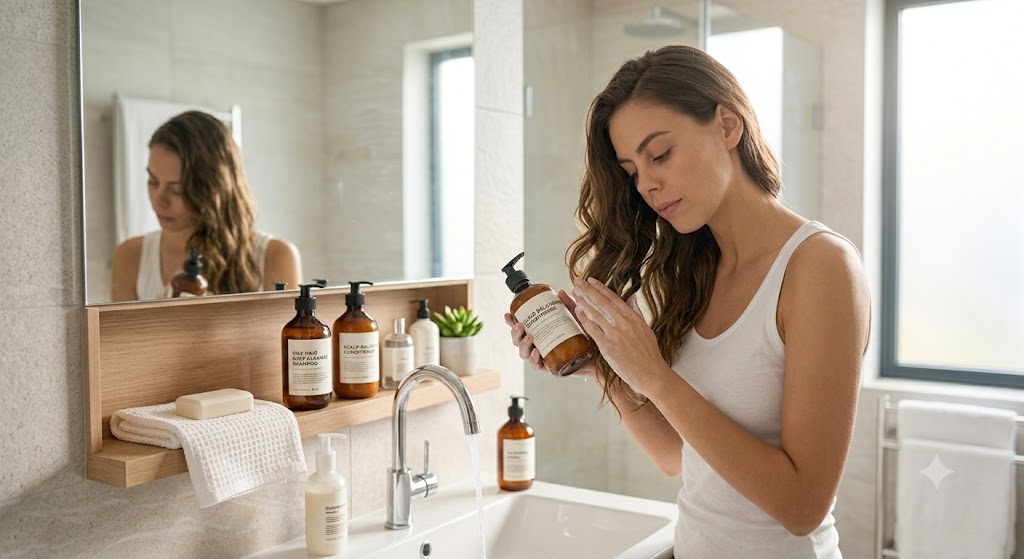
Root-Targeted Surfactant Application: Thoroughly saturate the scalp with lukewarm water for 120 seconds. Dispense a coin-sized amount of sulfate-free cleanser directly onto your fingertips. Work in circular patterns strictly across the dermal scalp. Never pile hair on top of your head or vigorously scrub your lengths; doing so creates catastrophic cuticle shearing. Allow the flowing suds to cleanse the ends as you rinse downward.
Squish to Condish (Hydro-Nutrient Infusion): Apply a silicone-free, plant-derived deep conditioner generously from mid-lengths to ends. Step momentarily out of the direct water stream. Cup curls in your palms, lifting them toward the roots while squeezing firmly. The distinctive wet squishing sound confirms water and fatty alcohols are being forced beneath the cuticle shingles into the inner cortex.
Conditioner-Saturated Wet Detangling: Never detangle curls on dry or partially damp hair. While hair is slick with deep conditioner, use a seamless, wide-tooth detangling comb. Begin exclusively at the bottom 2 inches of the hair, gently working out knots before advancing upward toward the root zone.
// QUICK WASH DAY PROTOCOL:
Step 1: Pre-poo dry lengths with Jojoba Oil for 20 mins.
Step 2: Cleanse scalp with sulfate-free shampoo (2 mins).
Step 3: Squish to condish with silicone-free mask.
Step 4: Detangle wet with wide-tooth comb from ends up.
Step 5: Apply LOC stylers; micro-plop with t-shirt.
6. In-Shower Live Action Checklist
Keep this interactive checklist open on your bathroom vanity to track your wash day milestones in real time:
Live In-Shower Execution Checklist
7. Advanced Moisture Sealing: The LOC vs. LCO Architecture
Simply applying water or a leave-in conditioner is ineffective without a chemical barrier; ambient air will rapidly draw water out of the cortex via osmotic evaporation, producing immediate halo frizz. To trap hydration inside the hair strand, clinical trichology emphasizes sequenced product layering:
Liquid (L): Water or an aloe-infused leave-in conditioner applied immediately to soaking-wet curls to saturate the inner cortex.
Oil (O): A botanical lipid barrier (such as argan, sweet almond, or jojoba oil) that creates an occlusive film over the hair cuticle to slow water evaporation. Learn more in our clinical review on how to properly apply hair serums.
Cream (C): A rich curl butter, pudding, or defining custard formulated with plant waxes and film-forming polymers that glue adjacent curl strands into defined clumps.
Which sequence should you use? If you have High Porosity hair, execute the LOC order (Liquid, Oil, then Cream) to seal open cuticle gaps before the cream locks down curl clumps. If you have Low Porosity hair, use the LCO order (Liquid, Cream, then Oil) so the lightweight cream can penetrate into the cortex before an oil layer blocks absorption.
8. Regional Considerations: Hard Water in the UK vs. US Climates
Environmental conditions significantly alter curl behavior across different continents:
The UK Hard Water Crisis: Over 60% of the United Kingdom (especially London and the South East) is supplied with hard water rich in dissolved calcium and magnesium carbonates. When these minerals interact with shampoos, they form an insoluble curdy precipitate that calcifies over curly hair cuticles. This mineral barrier blocks moisture absorption, causing persistent dryness and curl clumping failure. If you reside in the UK, install a multi-stage shower filter and incorporate a chelating wash containing Disodium EDTA once every three weeks.
US Climate Variations: In the United States, climate extremes require dynamic styling adjustments. In humid southern regions (such as Florida or Texas), high dew points cause atmospheric moisture to force open curl cuticles, leading to severe frizz. In these climates, use styling gels formulated with strong film-forming polymers (such as Polyquaternium-69). In dry, arid regions (such as Arizona or during winter in the Northeast), avoid high concentrations of simple glycerin, as it will draw moisture outward from your hair cortex into the dry air.
9. Drying Science: Diffusing vs. Micro-Plopping
How you transition your curls from soaking wet to dry dictates your final frizz profile:
The Terry Cloth Danger: Never dry curly hair with a traditional looped terry-cloth bath towel. The tiny cotton loops act like microscopic fishhooks that rip across delicate cuticles, fracturing curl clumps.
Micro-Plopping: Use a smooth microfiber towel or a clean 100% cotton t-shirt. Lay the fabric flat on a surface, flip your wet curls forward, and gently gather the curls up toward your scalp. Wrap securely for 15 minutes to absorb excess water without frictional damage.
Diffusing with Cold-Shot: Attach a deep-bowl diffuser to an ionic hair dryer. Set it to low heat and medium air velocity. Cup sections of curls in the diffuser bowl and hold them motionless against the scalp for 45 to 60 seconds before moving to the next section. Finish with a 30-second cold shot across each quadrant to contract the cuticular scales and lock in brilliant shine.
Eight hours of sleep on abrasive bedding can destroy an hour of wash day styling. Standard cotton pillowcases absorb natural oils and strip cuticular hydration throughout the night.
To preserve curl architecture until morning:
The Pineapple Technique: Flip your head forward and gather your curls loosely at the highest apex of your crown using a soft silk or satin scrunchie. Fasten it loosely with only a single loop—never tie it tightly. This ensures that only the underside of your hair rests against the bed, leaving your top curl clumps intact.
Satin Bonnets & Silk Pillowcases: Cover your pineapple with a breathable, 100% Mulberry silk or premium satin bonnet. The ultra-low friction coefficient of silk allows hair strands to slide smoothly across the surface without snagging, static electricity, or morning frizz.
Natural curl styling formulations frequently incorporate concentrated nut oils (such as almond or macadamia), plant botanicals, and citrus-derived essential fragrances. Prior to applying any new styling product across your scalp, apply a dime-sized amount along the inner forearm or behind the ear. Allow 24 hours to monitor for erythema, pruritus, edema, or burning sensations. If an allergic reaction occurs, discontinue use immediately.
Strand vs. Scalp Separation Rule
Never apply heavy shea butters, curl styling creams, or leave-in silicones directly onto your scalp tissue. Heavy occlusives clog the infundibulum of hair follicles, creating an anaerobic environment that triggers Malassezia yeast proliferation, seborrheic dermatitis, and secondary shedding. Keep all styling butters strictly 1 to 2 inches away from your roots. If you are using scalp-stimulating oils, consult our clinical breakdown on how to safely apply rosemary oil for hair growth.
12. Clinical Frequently Asked Questions
How often should you wash curly hair?
Most curly hair types thrive when washed once or twice per week. Washing daily strips natural scalp sebum, accelerating cuticle breakage, while washing less than once every ten days risks follicular buildup and yeast proliferation.
Can you brush curly hair when it is dry?
Never brush curly hair dry. Dry brushing fractures the delicate hydrogen bonds inside the curl clump, leading to severe mechanical frizz, cuticle chipping, and strand breakage. Detangle exclusively while hair is wet and saturated with slippery conditioner.
What is the LOC method for curly hair?
The LOC method is a layering technique consisting of Liquid (water or water-based leave-in), Oil (to penetrate or seal the cuticle), and Cream (a curl styling butter or custard to lock clumps together and reduce evaporation).
How do you protect curls while sleeping?
Preserve curl clumps by gathering hair loosely at the crown of your head (the pineapple method) using a soft silk scrunchie and sleeping on a pure mulberry silk or satin pillowcase to stop friction.
Why do my curls look frizzy after drying?
Frizz occurs due to lack of deep moisture, touching curls while they dry, drying with abrasive terry cloth towels, living in high-humidity zones without a gel barrier, or hard water mineral buildup.
Should curly hair use protein or moisture?
Healthy curls require an equilibrium of both. If your curls stretch excessively without returning to shape and feel mushy, they require hydrolyzed protein. If they feel brittle, stiff, and snap easily, they require deep moisture.






7 thoughts on “Ultimate Hair Care Routine for Curly Hair: Wash, Style, and Frizz-Free Protocol (2026 Guide)”
Comments are closed.