In modern cosmetic trichology, an overwhelming number of persistent hair complaints—ranging from inexplicable dullness, chronic dryness, and brittle mid-shaft snapping to greasy roots that resist cleansing—are caused by an invisible culprit: substantive product accumulation and hard water mineral calcification. When hair cuticles are smothered under layers of heavy cosmetic polymers and oxidized calcium carbonates, no luxury deep conditioning mask or botanical oil can penetrate the cortex.
Quick Summary: How to Clarify Hair Correctly
To clarify hair effectively: Saturate hair with warm filtered water, then apply a specialized clarifying or chelating shampoo containing Tetrasodium EDTA or Sodium C14-16 Olefin Sulfonate directly to the roots. Massage with fingertips for 3 minutes, allow the lather to dwell for 2 minutes to bind minerals, and rinse downward through the ends. Immediately follow with a rich, moisture-replenishing deep conditioner for 15 minutes to restore lipid flexibility.
Consumers frequently misinterpret product buildup as profound damage, responding with heavier butters, intensive bonding oils, and co-washes. This well-intentioned error exacerbates the issue, forming a water-repellent shell that accelerates moisture deprivation. Without strategic clarification, hair fibers suffer from mechanical fatigue and breakage.
Resetting this cuticular landscape requires more than an ordinary sulfate-free shampoo. It demands targeted surfactant chemistry and scientific chelation to strip away mineral deposits without rupturing the delicate endocuticle. This clinical guide breaks down the science of clarifying, features an interactive dosage calculator, and outlines the complete scalp detoxification protocol.
1. Cuticular Trichology: Hard Water Minerals vs. Polymer Buildup
To safely detoxify your hair, you must distinguish between the two primary classes of substantive accumulation that adhere to the keratin matrix:
Hard Water Mineral Calcification (Inorganic Deposition): Over 85% of households in North America and Western Europe utilize hard tap water containing elevated concentrations of dissolved calcium, magnesium, copper, and iron carbonates. According to clinical research indexed on PubMed, these mineral cations bind to negatively charged keratin, causing structural stiffness and significantly reducing fiber elasticity over time. Calcium forms insoluble mineral salts that stiffen cuticle scales into rigid plates, preventing them from closing flatly. Copper ions catalyze oxidative stress, degrading internal disulfide bonds when exposed to sunlight or heat styling.
Polymeric & Occlusive Buildup (Organic Deposition): Non-water-soluble silicones (such as Dimethicone and Amodimethicone), polyquaterniums, heavy waxes, and high-melting-point triglycerides adhere stubbornly to the outer epicuticle. While initially smoothing, these conditioning agents polymerize over repeated washes, creating an impermeable barrier that blocks ambient hydration.
Follicular Sebum Plugs (Scalp Dermis Accumulation): Natural sebum oxidizes when mixed with dead skin cells and styling residues, forming solid plugs inside follicular funnels. This localized congestion disrupts the scalp microbiome, leading to Malassezia yeast flare-ups, seborrheic dermatitis, and accelerated shedding.
The Clinical Distinction: Clarifying vs. Co-Washing:
Co-washing with cleansing conditioners deposits cationic surfactants without removing silicone polymers or heavy minerals. Over time, co-washing leads to “hydrophobic buildup,” where hair repels water, takes hours to dry, yet snaps effortlessly from extreme internal brittleness. Periodic surfactant clarification is non-negotiable for preserving fiber elasticity, especially within a balanced hair care routine for curly hair.
2. The Cuticular pH Spectrum: Why Chemistry Governs Fiber Swelling
Understanding hair clarification requires an examination of the pH scale. The human hair shaft has an isoelectric point of approximately pH 3.67, while the scalp acid mantle sits naturally between pH 4.5 and 5.5:
Substance / Cleanser Category
Average pH Level
Cuticular Response
Trichological Impact on Fiber
Pure Apple Cider Vinegar (Raw)
pH 2.8 – 3.2
Extreme Cuticle Contraction
Smooths surface; can cause brittleness if applied undiluted.
Healthy Hair & Scalp Acid Mantle
pH 4.5 – 5.5
Closed, Flat Shingles
Optimal moisture retention, balanced microbiome, zero swelling.
Standard Sulfate-Free Shampoo
pH 5.5 – 6.5
Mild Dilation
Gentle daily sebum removal without disrupting lipid layers.
Clarifying / Chelating Shampoo
pH 7.0 – 8.0
Controlled Cuticle Flaring
Allows anionic surfactants to access and dissolve trapped inner minerals.
Baking Soda (DIY Trend)
pH 8.5 – 9.0
Severe Cuticle Rupture
Destroys lipid bonds; strips cortex proteins; leads to chronic breakage.
3. Clinical Diagnostic Signs: When Hair Demands Clarification
Evaluate your hair against these primary diagnostic signs to determine if your cuticles require deep clarifying or chelation:
Diagnostic Indicator
Underlying Cuticle Pathology
Sensory & Visual Manifestation
Clinical Intervention Required
The “Velcro” Wet Texture
Calcium mineral crystallization causing cuticle shingling to flare outward.
Strands feel rough, sticky, and catch together during washing like sandpaper.
Full Chelating Wash with EDTA to bind divalent calcium ions.
Natural waves and curls go flat, stringy, and refuse to hold styling gel.
Root-focused clarifying cleanse to dislodge styling polymers.
4. Interactive Diagnostic Tool: Clarifying Frequency Calculator
Trichologist Clarifying Frequency & Formula Calculator
Input your water hardness and daily styling product profile to determine your exact clarifying schedule and surfactant formula:
5. Surfactant Chemistry: Clarifying vs. Chelating Formulations
Navigating the beauty aisle requires inspecting the International Nomenclature of Cosmetic Ingredients (INCI) label. As documented in the International Journal of Trichology, surfactant selection dictates whether a formulation merely degreases or actively chelates oxidized metal deposits without stripping essential cell membrane complex lipids:
Before applying clarifying shampoo, stand beneath a warm filtered shower stream for 3 full minutes. Cold water contracts the cuticles, locking minerals into the hair cortex. Warm water softens keratin and dilates the outer shingles, allowing surfactant micelles to contact bonded impurities. Ensure your hair is completely drenched from roots to tips.
Phase 2: Zoned Scalp Distribution
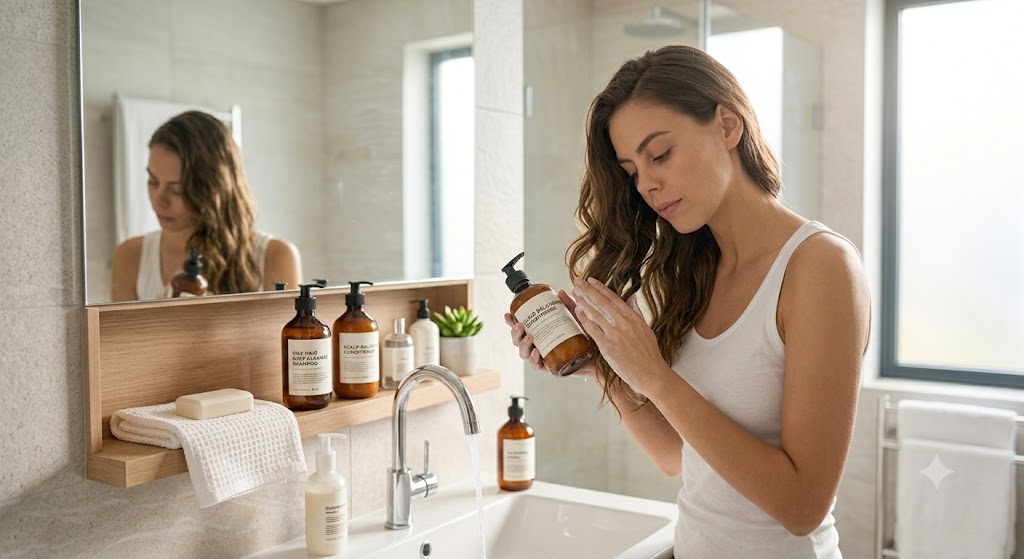
Pour a nickel-to-quarter-sized amount of clarifying shampoo into your wet palms and lather vigorously to activate the surfactant micelles. Part your hair and apply the foam directly onto your exposed scalp dermis. Never pile all your hair on top of your head and scrub roughly—this creates severe mechanical friction, breaking delicate cuticular edges.
Phase 3: The 3-Minute Chelation Dwell Window
Using the soft pads of your fingertips (or a flexible silicone scalp brush), massage the scalp in small, firm circles for 3 minutes. If your shampoo contains chelating agents (EDTA or citric acid), leave the lather undisturbed for 2 additional minutes. Chelating agents require dwell time to break covalent bonds with heavy mineral salts.
Phase 4: The Downward Waterfall Rinse
Rinse thoroughly with lukewarm water. Allow the rich suds to cascade downwards through your hair lengths and ends naturally. This gentle foam wash dissolves residual styling silicones without stripping away internal lipids. Rinse until the water runs clear and strands feel squeaky clean.
Phase 5: The Acidic Cuticle Seal
Clarifying leaves the hair cuticle open and primed for moisture absorption. Follow immediately with a rich deep conditioner or an acidic cuticle sealing treatment (pH 3.5 to 4.5). Work through lengths using wide-tooth comb techniques from our guide on how to detangle hair to restore inter-fiber slip.
7. Interactive In-Shower Clarifying Checklist
Track Your In-Shower Clarifying Execution
Check off each phase on your smartphone during your wash day session to verify complete detoxification:
8. Trichologist-Approved Formulations: What to Look For
To eliminate guesswork when selecting salon treatments, our clinical desk evaluates clarifying products by their molecular active agents rather than brand marketing:
Best for Hard Water Chelation
Medical EDTA / Ascorbic Acid Formulations
Formulas utilizing Disodium or Tetrasodium EDTA paired with natural vitamin C (ascorbic acid). These chelate microscopic mineral crusts without stripping natural sebum. Excellent for well water, chlorinated pools, and bleached hair experiencing greenish copper discoloration.
Best for Heavy Styling Polymers & Dry Shampoo
Olefin Sulfonate & Apple Cider Vinegar Formulations
Formulas centered around Sodium C14-16 Olefin Sulfonate and fermented organic acids. These create dense anionic micelles that bind oil-based styling waxes, water-insoluble dimethicones, and starch powders from dry shampoo, lifting them cleanly off the scalp.
Best for Fine Curls & Low-Porosity Hair
Gentle Amphoteric Surfactant Formulations
Formulations featuring Cocamidopropyl Hydroxysultaine and light botanical chelators like willow bark extract. These dissolve build-up along fine curl groupings without disturbing delicate wave definitions or triggering immediate moisture rebound.
Critical Safety Warnings: Mistakes That Lead to Hygral Fatigue
Observe these essential trichological rules when clarifying:
The Color-Treated Hair Risk: Clarifying within 14 days of an expensive salon balayage, bleach, or gloss will strip artificial color pigments, leaving hair brassy and faded. Always wait at least two weeks post-dye before performing a mild, color-safe chelating wash.
Never Clarify Without Deep Conditioning: Skipping a post-clarifying deep treatment leaves cuticles flared open. Environmental friction will chip away cuticle scales, causing severe split ends within days.
Avoid “Double Shampooing” with Clarifiers: Unlike gentle daily cleansers, clarifying shampoos should only be applied once during a wash session. A second round strips essential cell membrane complex (CMC) lipids.
Do Not Clarify Daily: Using clarifying shampoos more than twice weekly induces chronic sebum rebound, where the scalp produces excess oil to compensate for severe dehydration.
Once you strip away the mineral and polymer armor, your hair fiber is temporarily vulnerable. To prevent moisture loss, you must execute a structural post-clarifying rehydration routine:
Step 1: Protein-Free Deep Moisture: After clarifying, avoid high-protein restructuring masks. Your hair needs pure hydration (fatty alcohols like cetyl and stearyl alcohol, panthenol, and aloe vera) to restore flexibility. Introducing strong hydrolyzed proteins immediately after clarifying can trigger temporary protein stiffness.
Step 2: Rebuilding the Hydrophobic Envelope: Once your hair is rinsed clean and 80% towel-damp, lock in moisture using our proven methods for botanical nourishment, such as applying pure finishing serums as detailed in our guide on how to apply hair serum correctly.
Step 3: Scalp Barrier Balancing: If your clarifying routine addressed an oily scalp or flakes, apply a diluted botanical stimulator to clean follicles—such as our clinical protocol on how to apply rosemary oil for hair growth—to maintain scalp microcirculation.
10. Frequently Asked Questions
What is the difference between clarifying shampoo and chelating shampoo?
A standard clarifying shampoo utilizes strong anionic surfactants to strip away surface styling products, sebum, and non-soluble silicones. A chelating shampoo contains specialized sequestering agents (such as Tetrasodium EDTA or citric acid) designed to chemically bind and extract deep heavy metal ions and mineral deposits (calcium, magnesium, copper, chlorine) caused by hard water and swimming pools.
How often should you clarify your hair?
Frequency is strictly governed by your water hardness, hair porosity, and product usage. As a general clinical rule: oily or low-porosity hair exposed to daily styling products should clarify every 10 to 14 days. Dry, coarse, or high-porosity textured curls should clarify once every 3 to 4 weeks. Over-clarifying strips the natural protective sebum lipid envelope.
Will clarifying shampoo strip hair color or bleach?
Yes, aggressive clarifying immediately after coloring will accelerate the fading of semi-permanent and demi-permanent artificial pigment molecules because clarifying surfactants lift the outer cuticles. If you have color-treated hair, choose an EDTA-based chelating formula specifically labeled color-safe, and avoid clarifying for at least 14 days after color processing.
Can I use apple cider vinegar instead of a clarifying shampoo?
Apple cider vinegar (ACV) rinses are mild acidifying tonics (pH ~3.0) that help contract cuticle scales and break down light surface mineral film. However, ACV lacks anionic surfactant micelles and cannot dissolve heavy non-water-soluble silicones, polyquaterniums, or dense petrolatum residues. ACV serves as an excellent post-wash cuticular seal, not a replacement for medical-grade chelation.
Does clarifying shampoo cause hair loss or shedding?
Clarifying shampoo does not cause biological hair loss (telogen effluvium). However, by dislodging trapped sebum and loose hairs that were already detached from the follicle but held in place by sticky styling polymers, you may notice a temporary concentrated shed in the shower drain. Properly clarifying actually promotes healthy growth by eliminating follicular obstruction.
Can I clarify my hair if I have a keratin treatment or salon blowout?
No. Standard clarifying and chelating shampoos utilize anionic surfactants (such as olefin sulfonates) with elevated pH levels that will rapidly strip the hydrolyzed keratin and cross-linked glyoxylic acid bonds from the hair shaft. Avoid clarifying treatments for the entire intended lifespan of your keratin smoothing service.