⏱ 13 Min Read •
🔬 Trichologist & Salon Colorist Reviewed •
📅 Clinical Protocol Verified
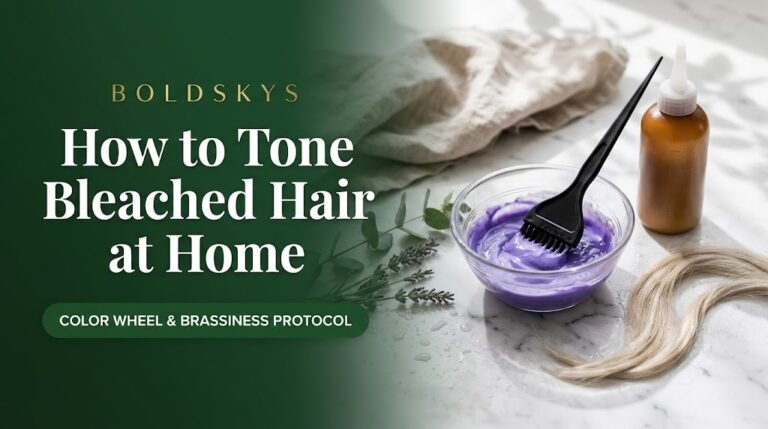
In the discipline of chemical hair modification, bleaching is only half the transformational equation. Lightening hair with persulfate bleaching salts strips natural eumelanin and pheomelanin, leaving behind raw, highly reactive keratin dominated by unappealing yellow, gold, or bright copper undertones. Transforming this harsh brassiness into a sophisticated platinum, cool ash, or luminous pearl blonde requires mastering the precise science of color wheel neutralization and low-volume oxidative toning.
Quick Summary: How to Tone Bleached Hair at Home
To tone bleached hair at home safely: Wash hair and towel-dry until 70% damp. In a non-metallic bowl, mix your chosen toner (violet-base for yellow undertones, blue-base for orange brass) with 10 Volume (3%) cream developer in a strict 1:2 ratio. Apply rapidly in 4 neat quadrants, process visually for 15 to 25 minutes, rinse with cool water, and seal immediately with an acidic, ceramide-rich conditioning treatment to contract cuticles.
Unfortunately, home coloring mishaps are remarkably common. Hundreds of thousands of consumers end up with muddy gray strands, patchy violet splotches, or brittle chemical breakage simply because they treated toner as a standard shampoo or used an unnecessarily aggressive 20 or 30-volume developer on freshly lightened hair.
Achieving clean, salon-grade tonality at home requires strict alignment with chemical principles: evaluating your current base lightness level, matching complementary color opposites, managing chemical dwell time, and protecting the damaged hair cuticle. This master trichology guide breaks down the Oswald Color Wheel, includes an interactive developer calculator, and provides the complete clinical at-home toning protocol.
1. Chemical Trichology: The Oswald Color Wheel & Pigment Counter-Balancing
Hair color theory operates on strict optical physics established by the classic color wheel. When light reflects off bleached keratin fibers, residual pheomelanin creates warmth. To neutralize that warmth into a cool, neutral, or natural tone, you must deposit the exact chromatic opposite on the color spectrum:
Level 9 to 10 Hair (Pale Yellow / Butter): At this high level of lift, the dominant remaining pigment is pale yellow. The chromatic opposite of yellow is Violet (Purple). A violet-based toner (often designated as ‘V’ or ‘.2’) cancels yellow light wavelengths, yielding crisp icy blonde, pearl, or platinum.
Level 7 to 8 Hair (Golden Orange / Raw Banana Peel): If your hair did not lift to pale yellow and remains stubborn gold or copper-orange, violet toner will fail completely. The chromatic opposite of orange is Blue. Applying a blue-based ash toner (designated as ‘A’ or ‘.1’) is chemically required to neutralize orange brass into a cool caramel or light mushroom blonde.
Level 5 to 6 Hair (Dark Red-Orange): Darker brass requires Green counter-pigmentation to neutralize fiery red reflections into neutral light brown.
The Golden Trichology Rule: Toner Cannot Lift Hair
A frequent misconception is expecting toner to make dark yellow or orange hair lighter. Oxidative toners deposit counter-pigments; they do not possess the alkaline persulfate power to lift natural melanin. If your hair is currently Level 7 orange, applying a Level 10 platinum toner will produce zero visible change. You must select a toner formulated at the exact level of your current lift.
Bleaching permanently alters the physicochemical structure of hair. According to clinical research indexed on PubMed, chemical oxidation degrades the hydrophobic 18-methyleicosanoic acid (18-MEA) lipid layer that naturally coats and seals cuticle shingles:
Porosity Level
Cuticular Condition
Toner Absorption Speed
Colorist Strategy
Low Porosity (Unbleached Roots)
Tightly compacted, flat overlapping shingles.
Slow penetration (Takes 20 to 25 minutes).
Apply toner here first; requires full processing time.
Trichologist Toner Selection & Developer Ratio Calculator
Select your current bleached hair shade and fiber sensitivity to calculate your exact toner base and developer volume:
4. Printable / Copy-Ready Salon Toning Protocol
At-Home Salon Toning Cheat Sheet
Preparation: Towel-dry freshly bleached hair to 70% dampness. Divide into 4 quadrants using plastic clips.
Formula Mixing: 1 part liquid toner (e.g., 1.4 oz) + 2 parts 10-Volume (3%) cream developer (e.g., 2.8 oz) in a non-metallic bowl.
Application: Roots and mid-lengths first with a tint brush. Work through porous ends during the final 3 to 5 minutes only.
Dwell Window: 15 to 20 minutes (visual strand checks every 5 mins). Rinse with cool water and seal with a pH 3.5 to 4.5 acidic conditioner.
5. Developer Chemistry: 10 Vol vs. 20 Vol vs. Acidic Demi-Permanents
The hydrogen peroxide developer acts as the chemical catalyst. Inspecting developer volumes reveals why many at-home toning attempts cause unwanted base shifting:
Developer Strength
Peroxide Percentage
Lift Capability
Cuticular Risk Profile
Best Clinical Application
5 to 7 Volume
1.5% – 2.1% H2O2
Zero Lift (Deposit Only)
Ultra-Low Risk; preserves cuticle shingles.
Highly damaged, bleached hair, or porous ends.
10 Volume (Standard)
3.0% H2O2
Zero Lift on natural base
Minimal swelling; opens cuticle just enough for pigment deposit.
The gold standard for at-home toning on freshly lightened hair.
20 Volume
6.0% H2O2
1 to 2 Levels of Lift
Moderate to High; lifts natural hair cuticles, exposing new warmth.
Avoid at home! “Bumps” your natural dark roots into an unnatural bright orange ring.
As documented in the International Journal of Trichology, elevated developer concentrations increase cuticular friction and degrade internal keratin disulfide integrity. Sticking to 10-volume developers prevents unnecessary lipid degradation.
Never apply toner to soaking wet hair or bone-dry hair. Soaking wet hair dilutes the developer, weakening deposit. Dry bleached hair acts like a thirsty sponge, soaking up toner unevenly and causing blotchy purple or gray streaks. Towel-dry freshly washed hair until it is approximately 70% damp. Gently detangle using a wide-tooth comb as explained in our guide on how to detangle hair.
Phase 2: Quadrant Sectioning
Part your hair down the center from forehead to nape, and from ear to ear across the vertex. Secure the 4 sections with plastic alligator clips. Never use metal hairpins, as metal triggers rapid peroxide breakdown.
Phase 3: Zoned Brush Deposition
Mix your 1:2 toner-to-developer ratio in your non-metallic bowl. Working quickly with your tint brush, apply the emulsion to your roots and mid-lengths first where hair is least porous. Take 1/4-inch sub-sections to ensure saturation. Leave the last 2 to 3 inches of your ends untouched until the final 5 minutes of processing.
Phase 4: Visual Processing Surveillance (15 to 25 Minutes)
Do not rely strictly on a kitchen timer. Oxidative toners darken in the bowl to deep violet, blue, or charcoal—this is completely normal chemical oxidation, not your actual hair color! Take a damp paper towel and wipe a small test strand at the 15-minute mark. Once the underlying yellow or orange disappears, your processing is complete.
Phase 5: Cool Water Acidic Rinse & Sealing
Rinse your hair thoroughly with cool water until the runoff is clear. Do not follow with harsh clarifying shampoos. Coat the hair immediately with a low-pH, protein-free bonding conditioner (pH 3.5 to 4.5) to contract the cuticle shingles. If hair feels severely dry post-process, integrate our proven techniques on how to apply hair serum correctly to seal ends against thermal stress.
7. Interactive Colorist Application Checklist
Track Your At-Home Toning Execution
Check off each phase on your smartphone before stepping up to the salon mirror:
Critical Colorist Warnings: Mistakes That Ruin Bleached Hair
Avoid these widespread chemical mishaps:
The “Green Hair” Trap: Applying an ash toner containing blue pigments onto Level 9 yellow hair creates green! Blue + Yellow = Green. Always use violet to cancel yellow, and save blue for orange brass.
The 24-Hour Patch Test: Oxidative hair toners contain paraphenylenediamine (PPD) and resorcinol derivatives. Always perform a patch test behind the ear 24 hours prior to rule out severe contact allergy.
Do Not Use 30 or 40 Volume Developer: Never mix toners with high-volume developers. High volumes blast open fragile bleached cuticles, melt weakened keratin, and trigger chemical breakage.
Oxidative toners, while gentler than bleach, still disrupt the stratum corneum of the hair shaft. To preserve cool blonde vibrancy without color fade:
Eliminate Hard Water Buildup: Hard water minerals bind rapidly to open cuticles, re-depositing brassy copper tones within days. Periodically detoxify strands by following our clinical guide on how to clarify hair using gentle chelating washes.
Support Scalp Follicles: Bleaching and toning place chemical stress on scalp dermis tissue. Soothe roots and encourage healthy hair cycles with our trichologist protocol on how to apply rosemary oil for hair growth.
Maintain Weekly Curl & Wave Nutrition: Textured bleached strands require moisture balance to prevent hygral fatigue. Maintain structural moisture using our structured hair care routine for curly hair.
9. Frequently Asked Questions
Should you tone bleached hair wet or dry?
Toning on towel-damp hair (70% dry) is the gold standard for at-home safety. Bleached hair has high porosity; damp fibers slow down excessive absorption, preventing muddy grayish patches while allowing the toner emulsion to glide evenly through the cuticular shaft.
What developer volume should I use with toner?
A 10 Volume (3% peroxide) developer is the ideal choice for toning. Its sole function is to gently open the outer cuticle scales and oxidize the toning pigments without lifting your natural base or inflicting additional chemical stress on compromised bleached keratin.
Why did my bleached hair turn purple or gray after toning?
This over-toning phenomenon occurs when hair is over-processed, highly porous, or left under the toner too long. Damaged cuticles rapidly pull in violet pigments. To correct this, wash immediately with a clarifying shampoo mixed with a tablespoon of deep conditioner to lift surface over-deposit.
How long does toner last on bleached hair?
Oxidative demi-permanent toners generally last between 4 to 6 weeks (approximately 15 to 24 washes). Longevity depends heavily on water hardness, shampoo sulfation, UV exposure, and the structural porosity of your hair fibers.
Can I tone my hair the same day I bleach it?
Yes, toning immediately after bleaching is standard practice because bleach solely removes melanin, leaving behind raw undertones. However, you must shampoo out all bleach residue thoroughly and avoid using developers higher than 10 volume.
What is the difference between purple shampoo and toner?
Toner is a demi-permanent oxidative chemical process that penetrates slightly beneath the cuticular envelope to neutralize undertones for up to 6 weeks. Purple shampoo is a direct-dye cosmetic cleanser that merely coats the surface with a temporary purple tint, washing away in 1 to 2 shampoos.