🔬 Cosmetic Color Chemistry Verified📚 Peer-Reviewed Literature Backed⏱ 16 Min Read
Few hair coloring frustrations compare to spending an hour applying permanent hair dye, rinsing carefully, and blow-drying your roots only to see stubborn, translucent, glowing silver or brassy gray hairs still shining right along your temples and part line. Even worse, when color does initially grab onto coarse gray strands, it frequently washes right back out within three to four shampoos, leaving hollow, faded roots against dark lengths.
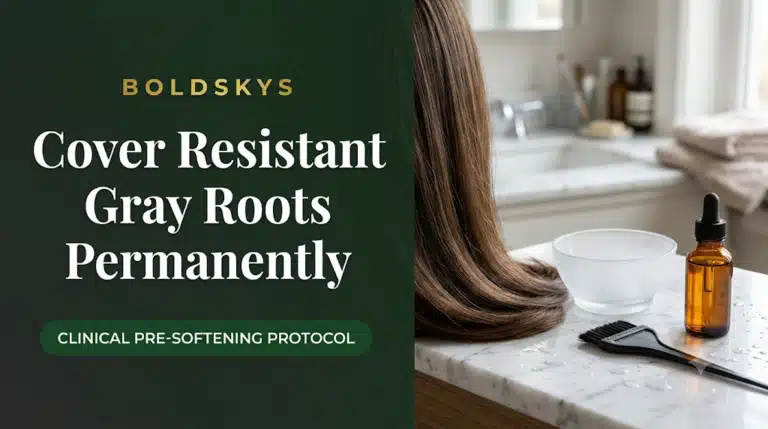
When permanent hair dye refuses to cover resistant gray roots, the problem is rarely the brand of dye—it is cuticular biophysics and pigment deficiency. Coarse gray hair possesses extra-thick, tightly sealed cuticle layers and zero natural melanin background. Achieving 100% opaque, salon-grade coverage at home requires 20-Volume peroxide pre-softening paired with Double Neutral (NN) high-pigment formulations.
To make permanent hair dye cover stubborn gray roots permanently: First, wash hair 24 hours prior with a chelating EDTA shampoo to strip invisible hard-water mineral buildup. Immediately before coloring, dab straight 20-Volume liquid hydrogen peroxide onto dry gray temples and roots using a cotton ball and warm with a blow dryer for 5 minutes to swell tight cuticles open (pre-softening). Without rinsing, apply thick coats of a Double Neutral (NN) permanent dye mixed 1:1 with 20-Volume cream developer, and process for a full 45 minutes.
✦ Master Colorist Brief (Google AI Overview & PAA Reference)
What does NN stand for in hair dye for gray coverage?
NN stands for “Double Neutral” (or Intense Natural). Unlike standard N shades, NN dyes contain double the concentration of balanced red, yellow, and blue background pigments required to replace missing melanin inside hollow gray hair shafts.
How do you pre-soften stubborn gray hair before dyeing at home?
Dab straight 20-Volume liquid hydrogen peroxide onto dry, stubborn gray roots along your hairline and temples using a cotton ball. Warm gently with a blow dryer on low heat for 5 minutes until dry, then apply your mixed permanent hair dye directly over the pre-softened roots without rinsing.
Should I use 10, 20, or 30 volume developer for stubborn gray roots?
Always use 20-Volume (6%) developer for permanent gray coverage. 10-Volume developer is too weak to swell tough gray cuticles open, while 30-Volume developer lifts too quickly and deposits too little pigment, leaving gray roots pale and translucent.
Why did ash hair dye turn my gray roots green or murky blue?
Pure ash (A) shades contain heavy blue-green pigments with zero warm red-gold background. Because white gray hair lacks natural warm melanin, pure ash deposits raw blue-green tones. Always mix 50% Double Neutral (NN) with 50% Ash (A) for cool gray coverage.
1. Trichological Fiber Biology: Why Gray Hair Has Armor-Plated Cuticles
Understanding why hair dye slides right off coarse gray hairs while grabbing instantly onto pigmented hair requires examining the structural transformation that occurs when a hair follicle stops producing melanin:
Hyper-Compacted Cuticular Shingles: As documented in cosmetic fiber microscopy studies indexed on PubMed, unpigmented gray and white hairs exhibit significantly thicker, more tightly overlapping cuticle layers (often 10 to 12 dense cell layers compared to 6 to 8 in pigmented hair) coated in a rigid 18-methyl eicosanoic acid (18-MEA) lipid barrier. Standard permanent dyes formulated for normal hair cannot swell these glass-like cuticles wide enough for oxidative dye precursors (PPD and couplers) to enter the deep cortex.
Absence of Underlying Melanin Background: Natural brown or dark blonde hair contains warm red, orange, and yellow melanin granules that act as an internal color foundation. Gray hair is completely hollow of melanin. When you apply a standard single-neutral (N) or pure ash (A) dye onto empty white keratin, the dye looks watery, translucent, or unnaturally cool-green because it lacks warm red-gold background pigments.
Hard-Water Mineral Armor: Calcium, magnesium, and iron ions from unfiltered shower water bind electrostatically to negatively charged gray cuticles, forming an invisible mineral shell that repels hair dye molecules unless removed beforehand with a chelating shampoo.
Cuticular Penetration Physics: Unprepped Gray Hair vs. Pre-Softened NN Coverage
2. Interactive Visual Comparison: Translucent Hollow Roots vs. Opaque NN Coverage
Gray Root Opacity & Dimensional Shine: Drag Slider to Compare
Before: Translucent Glowing Gray Roots
Coarse temple grays reflecting silver under light, patchy uneven dye grab, and rapid 3-wash fading.
After: 100% Opaque NN Root Blend
Seamless root-to-tip richness, balanced warm-neutral undertone, zero hot roots, and 6-week lock.
⬌
3. Interactive Lab: Gray-Percentage NN Ratio & Salon Savings Calculator
Custom Resistant Gray Formula & Annual Salon Savings Calculator
Select your percentage of gray hair at the roots and your desired tone to generate your exact salon-grade mixing formula and annual dollar savings compared to $165 salon root touch-ups every 5 weeks:
4. The 5-Stage Peroxide Pre-Softening & 45-Minute Saturation Protocol
Follow this exact 5-step clinical salon procedure to guarantee even, permanent pigment penetration on coarse, dye-resistant gray roots:
24-Hour Prior Chelating Mineral Purge: Wash your hair 24 hours before coloring using a chelating EDTA shampoo (such as Malibu C Hard Water Wellness or Ion Hard Water Shampoo) to strip calcium, magnesium, and silicone coatings from gray cuticles. Skip heavy conditioner and blow-dry 100% dry.
20-Volume Peroxide Pre-Softening: Pour 1 ounce of straight liquid 20-Volume hydrogen peroxide into a small bowl, saturate a clean cotton ball, and dab directly onto dry, resistant gray roots at your temples, crown, and part line. Aim a blow dryer on low warm heat over the roots for 5 minutes until hair feels dry to the touch. Do not rinse—proceed straight to color application.
Double Neutral (NN) Cream Compounding: Mix equal parts (1:1 ratio) of a Double Neutral (NN) permanent shade with 20-Volume cream developer in a non-metallic bowl. Never use 30-Volume developer on gray roots, as rapid oxidation destroys dye deposit.
Thick Frosting Saturation & 45-Minute Dwell: Part hair into thin 1/4-inch subsections. Lay thick, generous coats of color onto the roots—never scrape the brush flat against the scalp, which wipes dye off the hair. Start at the temples and hairline first, and process for a full 45 minutes.
Cool Emulsification & Acidic pH 4.0 Cuticle Lock: Splash a tiny amount of cool water onto roots, massage gently for 60 seconds to emulsify surface stain, rinse with cool water until clear, and seal cuticles with a low-pH acidic conditioner (pH 3.5 to 4.5). Wait 72 hours before shampooing.
“Never scrape hair dye flat onto gray roots. Lay it on thick like cake frosting and process for a full 45 minutes so pigments lock deep inside the cortex.”
5. Clinical Comparison Matrix: 10 Vol vs. 20 Vol vs. 30 Vol & Shade Series
Why won’t permanent hair dye cover my resistant gray roots?
Resistant gray hair has extra-thick, tightly compacted cuticle layers (up to 10–12 overlapping scales instead of 6–8) and lacks natural melanin pigment. Standard permanent hair dye lacks sufficient alkalinity and background warmth to penetrate these glass-like cuticles, causing color to sit on the surface and wash out within days.
What does NN stand for in hair dye for gray coverage?
NN stands for ‘Double Neutral’ (or Intense Natural). Unlike standard N (Natural) shades, NN formulas contain double the concentration of balanced red, yellow, and blue background pigments needed to replace missing melanin in hollow gray hair so roots look opaque rather than translucent or hollow.
How do you pre-soften stubborn gray hair before dyeing at home?
To pre-soften coarse gray roots, dab straight 20-Volume liquid hydrogen peroxide onto dry gray hair along your hairline and temples using a cotton ball. Warm gently with a blow dryer on low heat for 5 minutes until dry, then apply your mixed permanent hair dye directly over the pre-softened roots without rinsing.
Should I use 10, 20, or 30 volume developer for stubborn gray roots?
Always use 20-Volume (6%) developer for permanent gray coverage. 10-Volume developer is too weak to swell tough gray cuticles open, while 30-Volume developer lifts too fast and deposits too little pigment, leaving gray roots looking pale, translucent, and brassy.
Why did my gray roots turn bright orange or glowing red (‘hot roots’)?
Hot roots occur when you use a warm-toned shade or 30-Volume developer on virgin roots near the warm scalp. Scalp heat accelerates peroxide lifting, exposing warm orange undertones on remaining pigmented hairs while failing to deposit enough neutral pigment onto white hairs.
Can hard water stop hair dye from sticking to gray hair?
Yes. Calcium, magnesium, and iron minerals in unfiltered shower water form a microscopic mineral crust over coarse gray cuticles, physically blocking dye molecules from entering the cortex. Washing with a chelating EDTA shampoo 24 hours before dyeing removes this barrier.
How long should I leave permanent hair color on resistant gray hair?
Leave permanent hair color on resistant gray roots for a full 45 minutes. While standard box dyes state 25 to 30 minutes, coarse gray cuticles require the final 15 minutes of processing for dye polymers to fully oxidize and lock inside the cortex.
Why did ash hair dye turn my gray roots green or murky blue?
Pure ash (A) shades contain heavy blue-green pigments with zero warm red-gold background. Because gray hair has zero natural red or yellow melanin, applying pure ash dye directly onto white hair deposits raw blue-green pigment. Always mix 50% Double Neutral (NN) with 50% Ash (A) for cool gray coverage.
Should I wash my hair right before dyeing gray roots?
Wash your hair 24 hours before coloring with a clarifying or chelating shampoo, and skip heavy conditioners or leave-in oils. This removes product buildup while allowing a thin layer of natural scalp sebum to protect your skin during the 45-minute processing window.
Why does hair dye fade faster on my temples and hairline?
Hair along the temples and front hairline is typically the coarsest, most resistant gray on the head, and it receives the most exposure to facial cleansers, exfoliating acids, and UV sunlight. Always apply dye to your temples first so they get the longest processing time.
Our editorial desk formulates evidence-backed haircare and skincare protocols grounded in peer-reviewed trichology, oxidative color chemistry, and clinical dermatology literature.
Editorial & Chemical Color Disclaimer: The gray coverage protocols and peroxide pre-softening guidelines published on Boldskys are for educational, cosmetic, and informational purposes only. Always perform a 48-hour skin allergy patch test before applying oxidative hair dyes, and avoid getting liquid peroxide near the eyes.