Home›Hair Color›Toning Formulations: Wella T18 on Wet or Dry Hair Mistakes
⏱ 12 Min Read •
📚 Peer-Reviewed Research Backed •
🌿 Fact-Checked Editorial Protocol
🎧 Quick Listen: 3-Minute Wella T18 Audio Summary
Listen to the wet vs. dry porosity rules, 1:2 developer mixing ratios, and how to stop hair from turning purple.
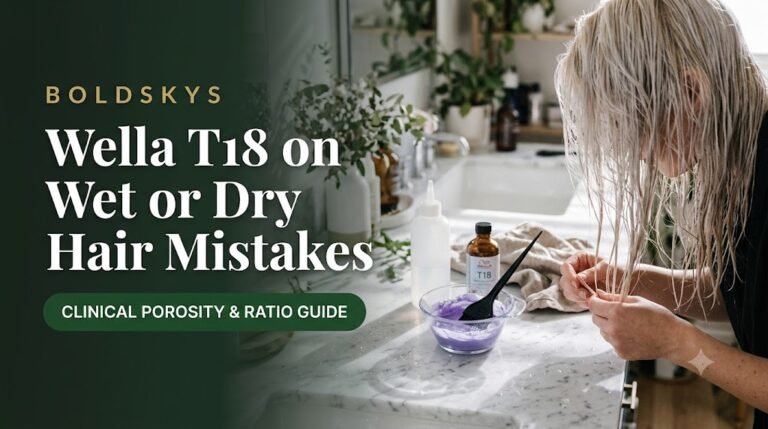
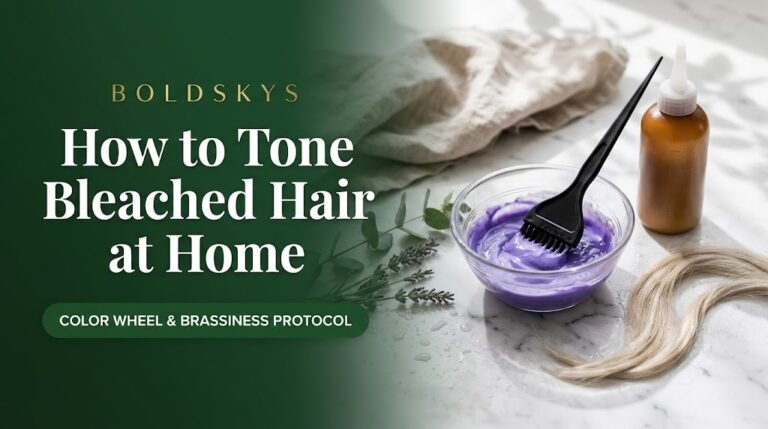
Among all liquid toner formulations used by both salon colorists and home blonding enthusiasts, Wella Color Charm T18 (Lightest Ash Blonde) stands as the undisputed industry standard for neutralizing yellow brassiness. However, the most fiercely debated question among users remains: should you apply Wella T18 to wet or dry hair? A single error in hair moisture saturation can transform your freshly bleached Level 10 platinum blonde into an inky violet, muddy slate-gray, or patchy disaster.
Direct Answer: Should You Apply Wella T18 on Wet or Dry Hair?
Apply Wella T18 to damp, towel-dried hair (approximately 70% dry), NEVER bone-dry and never dripping wet. Applying T18 to bone-dry bleached hair allows hyper-porous cuticles to absorb concentrated violet-blue dye pigments too quickly, creating dark purple or muddy gray ends in less than 5 minutes. Damp hair provides a micro-water buffer that slows trans-cuticular dye absorption, guaranteeing an even, clean, luminous platinum tone across roots and lengths.
The misconception that toners must always be applied to dry hair stems from permanent oxidative hair dye protocols. Liquid toners like Wella T18 operate differently; they are high-porosity corrective glazes formulated with a powerful violet-base direct and oxidative hybrid dye matrix. When applied to dry, highly porous bleached hair, the dry cortex absorbs the liquid formulation unevenly, resulting in severe over-toning.
Achieving predictable, salon-caliber platinum results requires understanding moisture buffering, developer volume mechanics, and rapid zonal placement. This master guide covers cuticular porosity physics, provides our custom Wella ratio calculator, and details the 5-stage application protocol.
1. Cuticular Porosity Physics: Why Water Acts as a Chemical Buffer
To understand why damp hair delivers superior results with Wella T18, one must examine the internal biophysics of bleached keratin fibers:
The Porous Void Phenomenon: Bleaching dissolves the protective 18-MEA outer lipid layer and strips natural melanin from the cortex, leaving microscopic voids between cuticular shingles. Dry, bleached hair acts like a dry sponge: when dipped into dye, it draws in liquid immediately through rapid capillary action.
Water as an Equalizing Buffer: When hair is damp (towel-dried until cool to the touch with no dripping), water molecules occupy the cuticular crevices. As documented in published cosmetic chemistry studies in the International Journal of Trichology, this internal water barrier slows down the penetration flux of synthetic dyes, allowing the colorist enough time to distribute the toner evenly before pigments lock into the cortex.
Developer Dilution vs. Deposition: Applying to dripping wet hair excessively dilutes your developer volume, dropping a 20 Vol down to an ineffective 5 Vol that cannot deposit pigment. Conversely, bone-dry hair causes premature grab. Towel-dried (70% dry) hair hits the ideal equilibrium: sufficient moisture to buffer pigment absorption without diluting the oxidative chemistry.
“Dry bleached hair is a sponge that hoards pigment into patchy purple spots; damp hair is a smooth highway that ensures an even platinum finish.”
2. Visualizing Tonal Saturation: Dry Application vs. Damp Towel-Dried Lift
Porosity Absorption: Drag Slider to Compare Tonal Results
Slide left and right to inspect the dramatic difference between applying Wella T18 to bone-dry hair versus towel-dried damp hair:
Applied to Bone-Dry Hair: Patchy & Purple
Inky lavender-gray ends, uneven pigment absorption, dull matte finish, and lingering yellow bands at the roots.
Applied to Towel-Dried Damp Hair: Pure Platinum
Uniform silver-white luminescence, zero purple spotting, 100% brass cancellation, and clean light reflection.
⬌
3. Interactive Diagnostic Tool: Wella T18 Ratio & Developer Calculator
Wella Color Charm T18 Mixing Ratio & Developer Selector
Select your hair lift level and current fiber health to calculate your exact 1:2 mixing ratios, developer volume, and dwell time:
4. The 4 Fatal Wella T18 Application Mistakes Home Colorists Make
Navigating liquid toners requires avoiding four specific chemical formulation traps that ruin blonde transformations:
Mistake 1: Applying to Bone-Dry Porous Hair: As established, dry hair pulls in concentrated violet dyes unevenly. The result is “toner grab,” where ends turn inky purple or dull charcoal gray while the roots remain bright yellow.
Mistake 2: Toning at Level 8 Instead of Level 10: Wella T18 is formulated to tone Level 10 pale yellow hair (the inside of a banana peel). If your hair is brassy yellow-orange (Level 8 or 9), T18 does not contain enough blue pigment to cancel the orange. The hair will remain brassy, leaving you with dry, damaged strands and zero color shift.
Mistake 3: The 1:1 Mixing Error: Unlike permanent hair dyes that use a 1:1 ratio, Wella Color Charm liquid toners require a strict 1:2 mixing ratio (1 part toner to 2 parts developer). Mixing 1:1 creates an overly concentrated, hyper-alkaline mixture that damages cuticles and over-deposits pigment.
Mistake 4: Washing with Shampoo Post-Toning: Shampooing immediately after toning strips freshly deposited dye molecules before they settle within the cortex. Always rinse with cool water and lock the cuticles with a low-pH conditioner.
5. Toning Myth vs. Fact: 10 Vol vs. 20 Vol Developer & Base Levels
Tap each card below on your mobile screen to flip and reveal the colorist truth:
MYTH: You MUST Use 20 Vol Developer
“The Wella box says 20 volume, so 10 volume will not work.”
(Tap to Reveal Truth)
FACT: 10 Vol is Often Safer
If hair is already lifted to a clean Level 10, 10 Volume deposits tone perfectly with zero cuticle burning and zero risk of shifting your natural base.
MYTH: T18 Lightens Dark Roots
“Toning over brown roots with 20 Vol blends my dark regrowth.”
(Tap to Reveal Truth)
FACT: Causes Unwanted “Base Break”
20 Volume developer lifts dark roots by half a shade, exposing warm, brassy red-orange undertones that look noticeably muddy.
MYTH: Leave On for Full 30 Minutes
“Always leave toner on for the full manufacturer time limit.”
(Tap to Reveal Truth)
FACT: T18 Tones Visually in 10-15 Mins
Porous bleached hair absorbs toner fast. Leaving it on for 30 minutes frequently leads to over-toning and muddy lavender ends.
“Toners have no clock; they operate on visual monitoring. When your hair hits pale platinum in the mirror, you rinse—regardless of the timer.”
6. The 5-Stage Salon Formulation Protocol (Exact 1:2 Ratio)
Follow this exact chemical application process to guarantee an even platinum blonde result:
Before mixing your toner, examine your bleached hair in natural daylight. The hair must match the pale yellow hue of the inside of a banana peel. If yellow-orange patches remain, T18 cannot neutralize them; treat remaining brassiness first using our comprehensive toning bleached hair color wheel guide.
Phase 2: Towel Dehydration (The 70% Sweet Spot)
After shampooing out your bleach, squeeze out excess water and blot thoroughly with a clean microfiber towel. Your hair should feel cool and damp to the touch, with zero droplets dripping when squeezed. Detangle gently with a wide-tooth comb.
Phase 3: The 1:2 Chemical Weigh-In
In a non-metallic plastic bowl, pour the entire 1.4 oz (42 ml) bottle of Wella Color Charm T18. Add precisely 2.8 oz (84 ml) of cream developer (use 10 Vol for fragile hair; 20 Vol for resistant yellow). Whisk thoroughly with a tint brush for 30 seconds until a uniform, creamy gel forms.
Phase 4: Root-First Zonal Application
Part hair into four quadrants. Begin applying the mixture to the warmest, most yellow sections first (typically the mid-lengths and roots). Leave porous, previously bleached ends untouched until the final 5 minutes of your dwell time. This prevents porous ends from over-absorbing violet dyes.
Phase 5: Visual Monitoring and Acidic Rinse
The toner will oxidize into a deep, dark purple on your head. Do not panic—this is normal oxidation. To check true color progress, wipe a small strand near your face with a damp towel. When the strand reaches pale silver-white (usually between 12 to 20 minutes), rinse thoroughly with cool water. Follow immediately with a low-pH conditioner (pH 3.5 to 4.5) to lock the cuticles.
Baseline Requirement: Hair must be lifted to Level 10 Pale Yellow.
Moisture State: Towel-dried damp (70% dry); never dripping wet or bone dry.
Exact Ratio: 1 part Wella T18 (1.4 oz) : 2 parts Developer (2.8 oz of 10 Vol or 20 Vol).
Application Order: Roots and warm mid-lengths first; apply to fragile porous ends for the final 5 mins only.
Dwell Time: 10 to 20 minutes (Monitor visually; rinse when pale platinum is reached).
Post-Toning: Rinse thoroughly with cool water; do not shampoo. Seal with a low-pH conditioner.
8. The Boldskys Bleach & Tone Silo (Master Internal Link Hub)
Master Blonde Toning Roadmap: Track Your Chemical Health
Maintaining clear platinum blonde hair requires systematic care across all stages of bleaching and toning. Check off each protocol in your regimen:
9. Frequently Asked Questions
Should you put Wella T18 on wet or dry hair?
Wella T18 should almost always be applied to damp, towel-dried hair (roughly 70% dry), not dripping wet and not bone dry. Applying T18 to bone-dry hair causes porous, freshly bleached cuticles to absorb violet pigments too rapidly, resulting in muddy purple or dark gray spots. Damp hair slows down absorption, ensuring an even, bright platinum result.
What happens if you apply Wella T18 to bone-dry hair?
Applying Wella T18 to bone-dry hair allows the porous cortex to pull in concentrated pigment without any water barrier. The ends and damaged areas will turn inky lavender, dark charcoal, or uneven violet-gray within 5 to 10 minutes, while remaining yellow at the roots.
Can you use 10 volume developer with Wella T18 instead of 20?
Yes. While the manufacturer recommends 20 volume developer for slight tonal lift, 10 volume developer is far safer on compromised, fragile hair. 10 volume deposits violet toner without additional cuticular damage or lightening the natural dark base at your roots.
Why did Wella T18 turn my hair dark purple?
Wella T18 turns hair dark purple when hair is over-processed and porous, applied to completely dry hair, or left on longer than 25 minutes. High porosity hair absorbs excess violet-base direct dyes. If this happens, use a clarifying shampoo with baking soda to safely lift the purple tint.
Why didn’t Wella T18 work on my yellow or orange hair?
Wella T18 is formulated with a violet base specifically calibrated to cancel pale yellow pigments at Level 10 (the color of the inside of a banana peel). It does not contain enough blue pigment to cancel orange or gold tones at Level 7 or 8. For orange tones, a blue-based toner like Wella T14 or T28 is required.
Do you shampoo after using Wella T18 toner?
No. Do not shampoo immediately after rinsing out Wella T18. Shampooing washes out freshly deposited toner molecules before they fully settle into the hair cortex. Rinse thoroughly with cool water and follow with a low-pH acidic conditioner to seal the cuticles.
Editorial & Chemical Color Disclaimer: The chemical formulation protocols and toner application guidelines published on Boldskys are intended strictly for educational, cosmetic, and informational purposes. This content is backed by professional cosmetic chemistry principles but does not constitute licensed chemical salon diagnosis. Always perform a strand test and patch test prior to chemical toning, and consult a licensed colorist or dermatologist if chemical burns, scalp irritation, or severe hair breakage occurs.
×
Before You Mix Your Toner!
Save your custom Wella T18 1:2 Developer Ratio & Damp Hair Checklist to your smartphone so you get the timing right in your bathroom.