Home›Hair Color›Color Rescue: How to Fix Over Toned Hair with Baking Soda
⏱ 12 Min Read •
📚 Peer-Reviewed Research Backed •
🌿 Fact-Checked Editorial Protocol
🎧 Quick Listen: 3-Minute Toner Removal Audio
Listen to the safe dilution ratios and acidic reset protocol to remove purple or muddy toner in one wash.
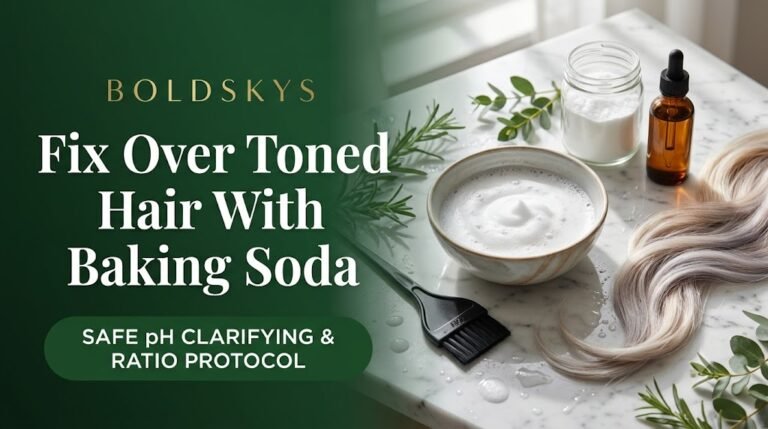
Achieving the perfect creamy vanilla or cool platinum blonde is a delicate balancing act. Unfortunately, porous bleached hair frequently over-absorbs violet, blue, or ash toner dyes within minutes, transforming golden strands into an unflattering, muddy dark gray, inky lavender, or murky blue. When faced with over-toned hair, panicking and applying a second round of bleach or commercial color stripper will destroy fragile hair fibers. The safest, most effective salon remedy relies on mild chemical physics: sodium bicarbonate (baking soda) clarifying.
Quick Summary: How to Fix Over Toned Hair with Baking Soda Safely
To fix over-toned hair safely at home: Whisk 1 tablespoon of baking soda into 2 tablespoons of clarifying shampoo until completely dissolved. Apply the creamy mixture to wet, over-toned hair sections and leave under a shower cap for 10 minutes. The mild alkaline pH (8.3) gently swells the hair cuticles, allowing the shampoo surfactants to wash away trapped purple or gray pigments. Rinse with warm water, follow immediately with a diluted apple cider vinegar rinse (pH 3.5 to 4.5) to compact cuticles, and apply a rich ceramide mask.
Consumers often encounter disastrous advice online advocating rubbing dry baking soda directly into hair strands or mixing it with concentrated lemon juice. Dry sodium bicarbonate acts like coarse liquid sandpaper, causing micro-fractures along vulnerable bleached hair shafts. Furthermore, mixing baking soda with lemon juice triggers an acid-base reaction that produces useless saltwater and carbon dioxide bubbles, neutralizing the color-stripping mechanism completely.
Safely removing excess toner requires harnessing alkaline cuticular expansion while cushioning strands with high-micelle cleansing agents. This master guide delivers the exact scientific protocol, our custom ratio calculator, and the crucial acidic reset routine.
1. Cuticular Biomechanics: Why Alkaline Baking Soda Lifts Synthetic Dyes
To safely lift artificial toner pigments without inflicting permanent cortex damage, one must understand how toner interacts with the hair fiber:
Trapped Toner Pigments: Toners rely on small oxidative or direct dye molecules (typically violet, blue, and cool ash pigments). In highly porous bleached hair, these pigments flood deep into the endocuticle and outer cortex, becoming trapped behind loosely aligned cuticle scales.
Alkaline Cuticular Expansion (pH 8.3): Pure sodium bicarbonate dissolved in water exhibits a mild alkaline pH of approximately 8.3. Normal healthy hair rests at an acidic pH of 4.5 to 5.5. Exposing hair to a controlled pH of 8.3 causes cuticle scales to lift and swell open safely without severing internal disulfide cystine bonds.
Surfactant Micelle Extraction: When baking soda is whisked thoroughly into clarifying shampoo, the shampoo’s anionic surfactants (like sodium laureth sulfate) slip beneath the raised cuticle scales. The hydrophobic tails of the surfactant bind to the synthetic dye molecules, while the hydrophilic heads attach to water, flushing the excess toner pigments down the drain during rinsing.
“Baking soda does not bleach or chemically dissolve hair color—it simply unlocks cuticular doors so clarifying surfactants can sweep excess toner out.”
2. Visualizing Tonal Lift: Over-Saturated Violet vs. Restored Cream Blonde
Tonal Clarity Comparison: Drag Slider to Inspect Lift
Slide left and right to inspect hair tone before and after a 10-minute baking soda clarifying wash:
Never apply baking soda directly to your scalp or strands in its dry crystalline state. Measure your prescribed amount of baking soda into a non-metallic bowl. Add your clarifying shampoo and whisk vigorously with a tint brush for 60 seconds until the granules are completely dissolved into a thick, uniform foam. Dissolving the sodium bicarbonate ensures even chemical pH distribution and prevents microscopic scratching of hair cuticles.
Phase 2: Warm Water Cuticular Softening
Step into the shower and soak your hair with warm water for 2 full minutes. Warm water softens keratin fibers and begins loosening the outer cuticular scales. Gently squeeze out excess water until strands are damp but not dripping wet.
Phase 3: Prayer-Hands Application (Zero Friction)
Scoop the foamed mixture and apply it directly to the over-toned sections. Use smooth “prayer hands” (pressing palms flatly together and gliding downward) to distribute the lather. Do not rub, scrub, or pile hair on top of your head—aggressive friction causes cuticular delamination on bleached hair fibers.
Phase 4: The 10-Minute Capped Dwell
Slip a plastic shower cap over your hair. The shower cap traps natural scalp heat, stabilizing the alkaline emulsion at body temperature to optimize surfactant lift. Set a timer for 10 minutes. At the 7-minute mark, wipe a small strand with a damp towel to check your tonal lift. Once the purple or dark ash hue has faded back to pale yellow, rinse thoroughly with warm water for 3 minutes.
Phase 5: Mandatory Acidic pH Contraction
Because baking soda raises hair pH to 8.3, cuticles remain flared and vulnerable after rinsing. You must immediately perform an acidic rinse to restore the natural pH balance, contract cuticular shingles, and lock in smoothness.
5. Color Correction Myth vs. Fact: Lemon Juice, Dish Soap & Bleach
Tap each card below on your mobile screen to flip and reveal the cosmetic chemistry truth:
MYTH: Mix Baking Soda with Lemon Juice
“Lemon juice adds natural acidity that speeds up color lifting.”
(Tap to Reveal Truth)
FACT: Neutralizes Both Ingredients
Alkaline baking soda and citric acid neutralize each other on contact, creating bubbling water and sodium citrate with zero color-lifting ability.
MYTH: Use Dawn Dish Soap Alone
“Dish soap removes grease, so it strips toner instantly.”
(Tap to Reveal Truth)
FACT: Severe Lipid Stripping
Dish soap strips essential cell membrane complex lipids without providing the controlled pH expansion needed to dislodge deep toner pigments, leaving hair parched.
Bleach baths inflict unnecessary oxidative trauma on hair that was just bleached, pushing fragile strands into gummy elasticity and breakage.
“Never use bleach to fix a toner mistake. Toners are temporary surface pigments; patient pH clarifying will save your hair integrity.”
6. The Mandatory Acidic pH Reset: Compacting Flared Cuticular Shingles
The single most dangerous mistake home colorists make when using baking soda is failing to execute an immediate acidic restoration step. According to published trichological studies in the International Journal of Trichology, leaving hair in an alkaline state induces chronic frizz, tangling, and cuticular chipping:
Why Cuticles Stay Raised: Keratin proteins possess an isoelectric point around pH 3.67. When hair is exposed to baking soda (pH 8.3), cuticular scales flare outward. If you simply rinse with water and air-dry, cuticles remain flared, causing light scattering (dullness) and extreme friction between strands.
The ACV Acidic Seal Formula: Mix 2 tablespoons of raw apple cider vinegar into 2 cups of cool distilled water (yielding a safe pH of ~3.8 to 4.2). Pour this solution slowly over freshly rinsed hair. You will immediately feel the strands transform from rough and squeaky to silky and slick as cuticles snap shut.
Lipid Replenishment: After your acidic rinse, coat strands in a ceramide-rich conditioning mask. To further lock in moisture, seal damp ends with 2 drops of biomimetic lipids from our clinical guide on squalane oil for hair and skin.
7. Printable / Copy-Ready Baking Soda Clarifying Card
Clinical Toner Clarifying Cheat Sheet
Ingredients: 1 tbsp Baking Soda + 2 tbsp Clarifying Shampoo + 2 tbsp Apple Cider Vinegar (in 2 cups water).
Step 1: Dissolve: Whisk baking soda into clarifying shampoo in a bowl until completely smooth.
Step 2: Apply: Smooth through damp over-toned sections using prayer-hands (no scrubbing).
Step 3: Dwell: Cover with a shower cap for 10 minutes. Check strand at 7 minutes.
Step 4: Rinse: Flush thoroughly with warm water for 3 full minutes.
Step 5: Acidic Seal: Pour diluted ACV rinse over hair; follow with a 10-minute ceramide moisture mask.
8. The Boldskys Color Correction Silo (Master Internal Link Hub)
Master Blonde Maintenance Roadmap: Track Your Color Health
Color correction requires balanced cuticular and follicular maintenance. Track your blonde recovery across our clinical pillars:
9. Frequently Asked Questions
Does baking soda permanently damage bleached hair?
When dissolved thoroughly in clarifying shampoo and used for under 15 minutes, baking soda does not permanently damage hair. Its mild alkaline pH (8.3) expands cuticles to dislodge synthetic direct dyes. However, applying dry undissolved baking soda or rubbing aggressively will cause mechanical abrasion and frizz. Always follow with an acidic rinse (pH 3.5 to 4.5).
How fast does baking soda remove toner from hair?
A single 10-minute application of baking soda combined with clarifying shampoo will typically lift 1 to 2 tonal levels of excess ash, purple, or gray toner immediately. For severely over-saturated navy or dark violet tones, a second session spaced 48 hours apart may be required.
Can I mix baking soda with dish soap or lemon juice to remove toner?
No. Mixing baking soda with dish soap creates extreme surfactant stripping that dissolves essential scalp sebum. Mixing baking soda with lemon juice triggers an acid-base neutralization reaction that converts both into salt and water with bubbling carbon dioxide, completely destroying their color-lifting efficacy.
Why did my bleached hair turn purple or dark gray from toner?
Toner turns hair purple or muddy gray when porous bleached cuticles absorb dye pigments too rapidly, or when the toner was formulated with a base tone that was too cool for your hair’s underlying yellow pigment. Over-processing beyond 15 minutes also forces excess pigment into damaged hair fibers.
What is the best shampoo to mix with baking soda to strip toner?
An anionic clarifying shampoo or an anti-dandruff shampoo containing selenium sulfide or zinc pyrithione works best. These shampoos possess strong cleansing micelles that bind to and flush out loosened toner molecules far more effectively than sulfate-free formulas.
What should you do immediately after using baking soda on hair?
Immediately apply a low-pH acidic rinse (such as diluted apple cider vinegar or a pH 3.5 conditioning sealant) followed by an intensive protein-moisture hair mask. This closes raised cuticles, locks in moisture, and restores natural hair shine.
Editorial & Chemical Color Disclaimer: The DIY clarifying protocols and color correction procedures published on Boldskys are intended for educational, cosmetic, and informational purposes. This content is backed by published cosmetic chemistry principles but does not constitute licensed chemical salon diagnosis. If chemical burning, severe scalp redness, or structural hair failure occurs, discontinue use immediately and seek professional salon assistance or dermatological evaluation.
×
Before You Step In The Shower!
Save your custom Baking Soda Clarifying Protocol to your smartphone so you can measure exact ratios in your bathroom.