Home›Hair Color›Color Correction: How to Remove Box Dye Without Bleach at Home
⏱ 14 Min Read •
📚 Peer-Reviewed Research Backed •
🌿 Fact-Checked Editorial Protocol
🎧 Quick Listen: 3-Minute Box Dye Removal Audio
Listen to the sulfur reduction chemistry, the 20-minute warm rinse rule, and how to prevent hair from turning dark again.
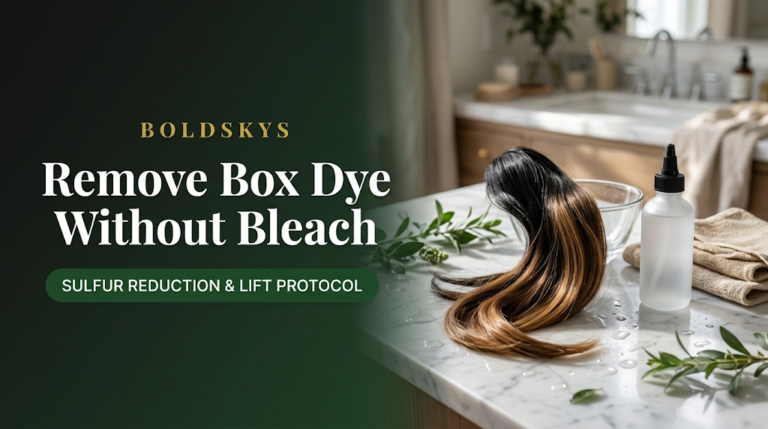
Applying permanent at-home box dye—especially jet black, dark espresso brown, or vibrant burgundy—frequently ends in regret when the shade turns out two to three levels darker than the model on the box. When faced with overly dark or muddy color, reaching for persulfate bleach to strip it out is a catastrophic mistake that melts disulfide keratin bonds and leaves hair orange and gummy. Fortunately, cosmetic chemistry offers a damage-free alternative: bleach-free sulfur reduction.
Unlike oxidative bleach, which permanently destroys both artificial dye and your natural hair protein, sulfur-based color removers reverse the chemical dyeing reaction. They shrink enlarged synthetic dye molecules back to their tiny, colorless pre-oxidized state so they can be flushed safely out of the hair shaft with warm water.
Quick Summary: How to Remove Box Dye from Hair Without Bleach at Home
To strip permanent box dye without bleach: Clarify hair 24 hours prior, then apply a bleach-free sulfur color reducer (containing sodium hydroxymethanesulfinate, such as Color Oops or Color B4) to 100% dry hair. Cover with a plastic cap for 20 minutes to shrink synthetic dye polymers. Next, execute the mandatory 20-minute warm water and clarifying shampoo flush (10 minutes rinsing, lathering, and 10 minutes final rinsing) to wash the shrunken monomers out before atmospheric oxygen can re-darken them. Avoid all peroxide dyes for 72 hours.
Thousands of home colorists try sulfur color removers, celebrate seeing their dark hair return to warm light brown in the shower, and then wake up the next morning horrified to find their hair has mysteriously turned jet black again. This phenomenon is not magic—it is basic oxidation chemistry caused by rushing the rinsing phase.
Successfully removing accumulated box dye at home requires mastering polymer shrinkage, executing an exhaustive mechanical surfactant flush, and neutralizing the underlying warm undertones exposed once the dark dye exits. This master guide breaks down the chemistry, provides our interactive lift calculator, and details the step-by-step protocol.
1. Dye Polymerization Chemistry: How Sulfur Reducers Shrink Artificial Pigments
To strip permanent box dye without damaging keratin proteins, one must understand how permanent oxidative dyes lock inside the hair cortex in the first place:
Oxidative Polymerization: Permanent box dyes contain tiny, colorless aromatic amine precursors—most notably para-phenylenediamine (PPD)—and dye couplers. When mixed with hydrogen peroxide developer (typically 20 Volume in box kits), these tiny monomers diffuse through open cuticles into the cortex. Once inside, peroxide triggers an oxidation reaction that links hundreds of tiny monomers together into massive, colored polymer chains. Because these newly formed polymers are huge, they become physically trapped inside the hair shaft and cannot wash out with shampoo.
Cleavage by Sodium Hydroxymethanesulfinate: Bleach-free sulfur color removers utilize powerful chemical reducing agents such as sodium hydroxymethanesulfinate or sodium hydrosulfite. As documented in cosmetic chemistry literature indexed on PubMed, these sulfur compounds donate electrons that sever the oxygen-driven cross-links between dye polymers.
Zero Disulfide Keratin Damage: Unlike persulfate bleach, which indiscriminately dissolves both artificial dye and your hair’s structural cystine disulfide bridges, sulfur color removers target oxidative dye bonds exclusively. Once severed, the huge colored polymers shrink back into tiny, colorless, water-soluble monomers ready to be rinsed out.
“Sulfur color removers do not dissolve hair color into thin air—they shrink giant dye molecules into tiny invisible ones. If you don’t rinse for 20 minutes, oxygen expands them back to black.”
2. Visualizing Pigment Extraction: Inky Box Black vs. Restored Underlying Lift
Oxidative Dye Polymer Shrinkage: Drag Slider to Compare
Slide left and right to inspect hair color transition before and after a single 20-minute sulfur reduction and warm flush cycle:
Before: Saturated Level 2 Box Black
Dense polymerized PPD pigment buildup, flat unnatural ink-black finish, and heavy metallic band saturation.
After: Extracted Level 6 Warm Chestnut
Artificial black polymers flushed out, intact disulfide keratin strength, exposing natural underlying warm brown lift.
Box Dye Pigment Density & Bleach-Free Removal Calculator
Select the type of dye currently in your hair and how many times you have layered it to calculate your exact removal chemistry, session count, and post-lift toning plan:
4. The 5-Stage Clinical Sulfur Reduction & 20-Minute Flush Protocol
Executing a sulfur color removal session successfully depends entirely on preparation and rinsing mechanics. Follow this exact 5-step protocol:
24 hours before using a color reducer, wash your hair with a strong anionic clarifying shampoo to strip away silicones (dimethicone), heavy oils, and styling resins that coat the hair shaft. Skip conditioner completely and blow-dry your hair 100% dry. Sulfur reducers must be applied to dry, barrier-free hair to diffuse evenly into the cortex.
Phase 2: Rapid Mixing and Generous Saturation
Open Part 1 (Activator) and Part 2 (Color Reducer) only when you are ready to apply immediately. Once combined, the active reducing sulfur gas begins dissipating into the air within 15 minutes. Apply the liquid generously starting at the darkest mid-lengths and ends, working upward toward the roots last (since scalp heat accelerates chemical processing).
Phase 3: Airtight Thermal Processing (20 Minutes)
Cover your saturated hair tightly with a plastic processing cap to trap natural body heat and prevent the product from drying out—reducing chemistry only works while moist. Process for exactly 20 minutes. Do not leave it on for an hour; once the reducing reaction finishes at 20 minutes, further dwell time yields zero additional lift.
Phase 4: The Mandatory 20-Minute Warm Water & Shampoo Flush
This is the single most critical step in the entire protocol. Step into the shower and rinse your hair under warm running water for 10 full minutes (set a timer on your phone!). Warm water swells the cuticles slightly so the shrunken, colorless dye monomers can exit. Next, apply a generous amount of clarifying shampoo, lather gently for 2 minutes, and rinse for another 10 full minutes. Repeat the shampoo lather and rinse one final time to guarantee zero unwashed monomers remain trapped inside.
Finish with a cool-water rinse and a low-pH acidic conditioner (pH 3.5 to 4.5) to snap cuticles shut. Because permanent box dye developer originally lightened your underlying natural pigment, your hair will now appear warm copper, orange, or golden brown. Neutralize this warmth safely without developer using a blue-pigmented deposit mask, or review our toning color wheel guide once 72 hours have passed.
5. The Re-Oxidation Trap: Why Hair Turns Black Again Overnight
Understanding why hair mysteriously re-darkens after using Color Oops or Color B4 saves you from repeating the process unnecessarily:
The Chemistry of Re-Oxidation: Sulfur reducers do not destroy dye molecules; they simply break the chemical bonds holding them together in big chains. If you rush your shower and rinse for only 3 minutes instead of 20 minutes, millions of microscopic, colorless dye fragments remain lodged inside your hair cortex.
Atmospheric Oxygen & Peroxide Triggers: Over the next 12 to 24 hours, oxygen in the air naturally reacts with those trapped fragments, re-linking them back into large dark polymers. Worse yet, if you immediately apply a new box dye or toner containing hydrogen peroxide developer, the peroxide instantly re-oxidizes all remaining fragments within 60 seconds, turning your hair jet black again.
The Strand Test Verification: Before applying any developer-based dye after 72 hours, snip a tiny hidden strand of hair and dab 10-volume peroxide developer onto it. If the strand turns dark within 5 minutes, unwashed dye monomers are still present and you must perform a second sulfur reduction and 20-minute flush.
“Always run a 5-minute peroxide strand test 72 hours after using a color remover. If the strand turns black, hidden dye molecules are still waiting inside your hair.”
6. Removal Method Matrix: Sulfur Reducers vs. Vitamin C vs. Bleach Baths
Choosing the wrong pigment-stripping method leads to severe breakage or wasted effort. Compare the four primary home dye-removal options below:
Removal Method
Active Chemistry
Best Dye Type Target
Structural Hair Impact
Sulfur Color Reducer (Color Oops / B4)
Sodium Hydroxymethanesulfinate (Reducing Agent)
Permanent Oxidative Box Dye (Black, Brown, Red)
Zero Bond Breakage: Does not lift natural melanin or melt keratin.
Vitamin C + Clarifying Shampoo
Ascorbic Acid (Mild Acidic Chelation)
Semi-Permanent Direct Dyes & Temporary Tints
Low Impact: Mild cuticular dryness; ineffective on permanent black dye.
Prep (24 Hrs Prior): Clarify hair with anionic shampoo, skip conditioner, and blow-dry 100% dry.
Step 1: Mix & Apply: Mix sulfur color reducer parts immediately; saturate dry dyed hair from ends to roots.
Step 2: Process: Cover tightly with a plastic cap for 20 minutes under gentle warmth.
Step 3: First Rinse: Rinse under warm running water for 10 FULL MINUTES (use a timer).
Step 4: Clarify & Second Rinse: Lather with clarifying shampoo, rinse 10 FULL MINUTES, repeat shampoo once.
Step 5: Protect: Seal with acidic conditioner (pH 4.0). Wait 72 hours before applying any peroxide dye.
9. The Boldskys Color & Bond Recovery Silo (Master Internal Link Hub)
Master Color Correction Roadmap: Track Your Hair Integrity
Safely lifting dark box dye and toning warm undertones requires coordinated care across our trichology and color pillars. Track your steps below:
10. Frequently Asked Questions
How can I remove permanent box dye from my hair without bleach?
The safest and most effective way to remove permanent oxidative box dye without bleach is using a bleach-free sulfur-based color reducer (such as Color Oops or Color B4). Unlike bleach, which destroys natural melanin and breaks keratin bonds, sulfur reducers reverse oxidation by shrinking synthetic dye molecules so they can be washed out of the hair shaft with warm water and clarifying shampoo.
Why did my hair turn dark again the day after using a color remover?
Hair turns dark again due to ‘re-oxidation.’ Sulfur color removers shrink artificial dye molecules rather than dissolving them. If you do not rinse your hair with warm water and clarifying shampoo for a full 20 minutes, tiny unwashed dye monomers remain trapped in the cortex. When exposed to oxygen in the air or peroxide in a new hair dye, they re-expand and turn dark brown or black again.
Does Vitamin C and Head & Shoulders actually remove permanent box dye?
Crushed Vitamin C (ascorbic acid) mixed with clarifying shampoo effectively fades semi-permanent or demi-permanent direct dyes by 1 to 2 shades. However, it cannot break the large polymerized molecules of permanent oxidative box dye (especially dark brown or black). For permanent box dye, a sulfur-based color reducer is required.
Why does my hair look orange or brassy after removing black or dark brown box dye?
Permanent box dyes contain hydrogen peroxide developer, which permanently lightened your natural hair color underneath at the exact moment you applied the dark dye. When the color remover strips away the dark artificial pigment, it exposes that underlying warm orange or brassy lift. You can neutralize this warmth using a blue-based deposit-only conditioner.
How many times can you use a sulfur color remover without damaging hair?
Because sulfur color removers contain zero bleach or ammonia, they do not break internal disulfide bonds. You can safely perform up to 2 or 3 applications spaced 48 hours apart to lift stubborn layers of accumulated black box dye, provided you replenish surface moisture and lipids between sessions.
Can I dye my hair right after using a box dye remover?
No. You must wait at least 48 to 72 hours before applying any oxidative hair dye or toner containing hydrogen peroxide developer. If any microscopic trace of shrunken box dye remains inside your hair, applying peroxide developer will immediately re-oxidize those molecules, turning your hair dark brown or black within minutes.
Editorial & Chemical Color Disclaimer: The color correction protocols and sulfur reduction guidelines published on Boldskys are for educational, cosmetic, and informational purposes only. Because individual hair history varies, always perform an allergy patch test and a hidden strand test before applying chemical color removers, and consult a licensed colorist if previous metallic salts or henna dyes are present in your hair.
×
Before You Start Your Color Removal!
Save your 20-Minute Warm Flush & Bleach-Free Box Dye Removal Cheat Sheet directly to your phone so your hair never re-oxidizes dark again.