Quick Diagnostic Answer: How Do You Accurately Identify Your Hair Type?
To accurately identify your hair type, evaluate four core scientific parameters on 100% clarified, product-free, air-dried hair: Curl Pattern (Type 1 straight to Type 4 coily using the Andre Walker taxonomy), Strand Diameter (comparing a single strand against a standard sewing thread to establish fine, medium, or coarse caliber), Cuticular Porosity (evaluating moisture absorption dynamics via the water float test), and Scalp Density (assessing follicle concentration along the natural cranial part-line).
1. The Biological Science: Follicle Morphology & Keratin Polypeptides
Human hair typing is not a mere cosmetic exercise; it is rooted in subcutaneous cellular anatomy, follicle morphology, and the biochemical synthesis of hard alpha-keratin. Every single hair fiber emerging from the scalp reflects the shape of the follicular bulb anchored within the dermal layer.
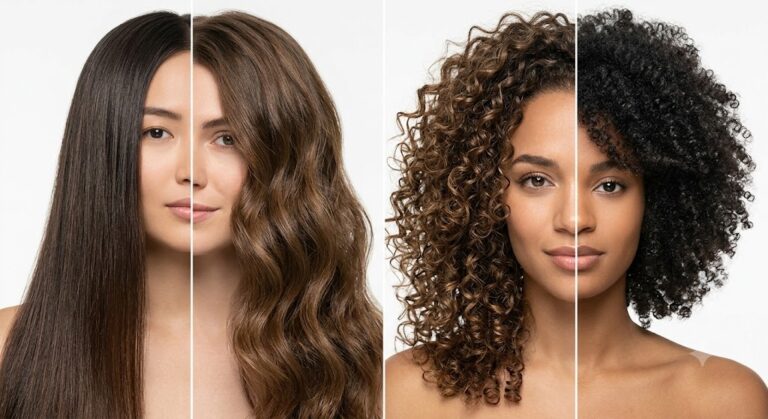
Under electron microscope magnification, human hair follicles display marked anatomical differences. In straight hair (Type 1), the follicle is oriented perpendicularly to the dermal surface, featuring a symmetrical, circular bulb. As matrix keratinocytes divide, they push protein chains upward symmetrically, producing a round hair fiber that grows straight with minimal curvature.
In wavy, curly, and coily hair (Types 2, 3, and 4), the follicle bulb is positioned at an oblique or hooked angle within the dermis. According to research indexed in the National Institutes of Health (PubMed), this curved trajectory deposits cysteine amino acids and disulfide bonds irregularly across opposite sides of the shaft. The uneven tension causes the emerging strand to twist continuously around its vertical axis, creating waves, curls, or compressed coils.
Accurately determining this underlying architecture prevents product mismanagement. Applying dense shea butters to fine straight hair causes severe follicle suffocation and limpness, while using light alcohol-based sprays on coarse coils triggers cuticular desiccation. Once you determine your curl type, integrate it directly with our complete hair care routine for curly hair to maximize hydration and definition.
Related Scientific Read: Proper mechanical handling prevents cuticle fracturing during tests. Read our clinical protocol on how to safely detangle natural hair without root tension.
2. The Andre Walker System: Comprehensive 1A to 4C Classifications
Developed by celebrity stylist Andre Walker and adapted by clinical trichologists globally, the hair typing taxonomy divides human hair into four distinct major classes (1, 2, 3, and 4), which are further subdivided into twelve calibrated sub-types (A, B, and C) based on pattern diameter and contraction behavior:
Category & Type
Physical Geometry
Sebum Migration Speed
Primary Regimen Directive
Type 1A
Pin-straight, ultra-fine, lacks volume completely
Rapid (within 12–24 hours)
Clarifying cleansers, weightless root volumizers
Type 1B
Straight with subtle body; holds minor curling iron bends
Moderate to fast
Balancing cleansers, light water-based hydration
Type 1C
Straight, coarse, resistant to styling tools, slight body wave
Moderate
Frizz control, thermal protection sprays
Type 2A
Loose, elongated S-waves; flat root area; fine caliber
Moderate
Light styling foams, diffuse drying on low heat
Type 2B
Defined S-waves starting mid-lengths; noticeable crown frizz
Slow to moderate
Sea-salt-free wave sprays, anti-humidity gels
Type 2C
Deep, prominent waves with early ringlet loops; prone to coarseness
Slow
Curl enhancing creams, micro-plopping with microfiber
Sharp Z-pattern angles; less clump definition; up to 70% shrinkage
Negligible migration
Heavy lipid sealing (Shea/Castor), low-manipulation styles
Type 4C
Ultra-tight coils; delicate cuticular layer; maximum shrinkage (75%+)
Negligible migration
Protective styling, hot oil infusions, intensive hydration
3. Strand Diameter & Caliber: Fine, Medium, vs. Coarse Architecture
Strand diameter refers strictly to the cross-sectional caliber of an individual hair fiber, entirely independent of how much hair is on your head. Many women confuse high-density fine hair with coarse hair, leading to severe product errors:
Fine Hair: Consists solely of the outer cuticular sheath and the inner cortex, completely lacking a central medulla. Fine strands are whisper-light, soft to the touch, and snap easily under mechanical stress. Heavy plant butters collapse fine hair instantly, turning it stringy and limp.
Medium Hair: Displays a balanced cortex-to-cuticle ratio with an interrupted, sporadic medulla core. It is the most resilient, pliable hair type, holding heat curls and blowouts easily while tolerating a broad spectrum of cosmetic emollients.
Coarse Hair: Features a thick cuticular armor, a dense cortex, and an expansive, unbroken core medulla. A single coarse strand feels wiry, stiff, and substantial between the fingertips. It possesses immense tensile strength, but requires intensive lipid conditioning to maintain elasticity and suppleness.
// THE TRICHOLOGIST THREAD TEST PROTOCOL:
Step 1: Pluck or collect a single clarified shed hair strand.
Step 2: Cut a 2-inch piece of standard industrial sewing thread.
Step 3: Lay both parallel on a pure white sheet of printer paper.
Step 4: If hair is narrower than thread = FINE.
Step 5: If hair matches thread diameter = MEDIUM.
Step 6: If hair is visibly thicker/stiffer than thread = COARSE.
4. Interactive Complete Hair Diagnostic Tool
Input your structural hair metrics below to discover your comprehensive clinical hair profile and custom product regimen:
Complete Hair Profile Diagnostic Engine
5. Cuticular Porosity: Testing Low, Medium, and High Porosity Mechanics
Porosity represents your hair cuticle’s physiological ability to absorb, transport, and lock in moisture. It is determined by the condition of the overlapping keratin shingles that form the outer protective shield of each strand:
Low Porosity Hair (Tightly Bound Cuticles): Cuticles overlap tightly like roof tiles and are sealed with a dense layer of 18-methyleicosanoic acid (18-MEA). Water beads up on the surface and runs off. Products sit on the hair, creating immediate buildup. Low porosity hair requires warm water and mild heat to gently expand the cuticular plates before applying lightweight humectants.
Medium Porosity Hair (Healthy Physiological Balance): The cuticle plates maintain balanced alignment. Moisture enters steadily and evaporates gradually. This hair type requires minimal maintenance beyond regular cleansing and light conditioning to maintain lipid equilibrium.
High Porosity Hair (Compromised / Chipped Cuticles): Cuticle shingles are raised, chipped, or missing due to genetic factors, bleach, chemical perms, or heat styling. Water penetrates the inner cortex instantly, but evaporates just as quickly into dry air, producing chronic halo frizz and split ends. High porosity strands require heavy plant lipids, hydrolyzed proteins, and acidic rinses (pH 4.5–5.5) to seal cuticular gaps.
Heavy lipid butters (Shea), castor oil, hydrolyzed wheat protein
6. Scalp Follicle Density & Wet Keratin Elasticity Tests
To complete your hair profile, assess follicle concentration and structural elasticity:
The Part-Line Scalp Density Evaluation: Stand in front of a well-lit mirror. Allow dry hair to fall into its natural parting without combing or styling. If your scalp is clearly visible from several feet away, you have Low Density (focus on lightweight volume). If your scalp is visible only along the immediate line, you have Medium Density. If you cannot see your scalp at all without manually parting sections with clips, you have High Density (requires sectioning for thorough product application).
The Wet Elasticity Stretch Test: Wet a shed hair strand thoroughly with warm water. Hold the ends between your thumbs and index fingers, and pull gently:
Balanced Elasticity: Stretches approximately 25% to 30% of its resting length and snaps back cleanly without breaking.
Low Elasticity (Moisture Deficient): Snaps immediately under minimal tension with zero stretch (requires intensive emollients and fatty alcohols).
High Elasticity (Protein Deficient): Stretches excessively, curls up like pulled ribbon, feels gummy or mushy, and fails to return to shape (requires hydrolyzed keratin or silk protein reconstruction). Learn how to preserve structural integrity overnight in our ultimate night hair care routine guide.
7. The Trichology Diagnostic In-Vanity Checklist
Check off these essential clinical steps directly on your phone while testing at home:
Live Hair Typing In-Vanity Checklist
8. Environmental Factors: Hard Water Impact in the US and UK
Environmental conditions significantly skew hair typing results across different geographic zones:
The UK Municipal Hard Water Impact: Over 60% of homes across the United Kingdom (especially London and the South East) receive hard water rich in dissolved calcium and magnesium carbonates. These minerals bond to hair proteins, forming an insoluble film that artificially mimics coarse, low-porosity hair. Before performing hair typing in the UK, wash with a chelating cleanser containing Disodium EDTA to remove calcified mineral crusts.
US Regional Humidity and Dew Points: In the United States, climate extremes alter hair behavior. In humid southeastern states (such as Florida and Texas), high atmospheric dew points force open cuticles, making Type 2 waves look like unkempt Type 3 curls. In arid southwestern regions (such as Arizona), extreme dryness dehydrates curls rapidly, giving them a false high-porosity reading. Always conduct your typing tests in a climate-controlled room.
Caution: Never Type Chemically Altered or Heat-Damaged Strands
Never attempt to type hair that has been bleached, relaxed, keratin-treated, permed, or subjected to frequent 400°F flat irons. Chemical treatments permanently break disulfide keratin bonds, destroying natural curl patterns and creating artificially high cuticular porosity. Assess only the first 2 inches of natural virgin new-growth emerging from the scalp to identify your true genetic hair type.
Strand vs. Scalp Separation Rule
Hair typing determines what your strands need; your scalp condition dictates what your cleanser needs. You can have fine, high-porosity, fragile curls on your ends while simultaneously struggling with an oily, seborrheic scalp at your roots. Never apply heavy curl styling butters directly to the scalp tissue, as they choke follicles and feed Malassezia yeast. If using stimulating botanicals, consult our clinical breakdown on how to safely apply rosemary oil for hair growth.
10. Frequently Asked Clinical Questions
Can you have multiple hair types and porosities on a single scalp?
Yes, having multiple hair types is biologically normal. Most individuals display looser curl patterns (like Type 2 waves) at the nape and crown, while framing tighter Type 3 spirals along the temples. Porosity can also vary significantly between sun-exposed canopy layers and shielded lower layers.
Is the hair porosity water float test scientifically accurate?
The water float test is a reliable home screening method, provided the strand is freshly clarified and completely devoid of sebum or oils. Residual surface lipids create hydrophobic surface tension that can cause high-porosity hair to float falsely.
What is the biological difference between hair density and strand thickness?
Hair thickness refers strictly to the cross-sectional diameter of an individual hair fiber (fine, medium, coarse). Hair density refers to the concentration of active follicular units growing per square centimeter across the cranial scalp.
Can systemic hormonal fluctuations change your natural hair type?
Yes. Dramatic endocrine shifts during puberty, pregnancy, postpartum recovery, thyroid dysregulation, and menopause alter follicular receptor sensitivity and keratin synthesis, transforming straight hair into waves or altering natural curl tightness.
How does low porosity hair react to styling products?
Low porosity hair possesses tightly closed, overlapping cuticular shingles bound by hydrophobic lipids. Water and rich styling creams cannot penetrate easily, causing products to sit on the strand as a visible white residue, leading to rapid product buildup.
Why is high porosity hair chronically dry and prone to tangling?
High porosity hair has fractured, raised, or permanently missing cuticle scales resulting from genetic factors, chemical bleach, or thermal damage. It absorbs moisture instantaneously but loses it just as quickly through evaporation, resulting in constant dryness.