
A good hair care routine does not have to involve a long list of products or complicated steps. In many cases, the most useful routine is one that fits your hair type, scalp needs, lifestyle, and how your hair responds to everyday care.
Hair can behave very differently from person to person. Straight hair may become oily quickly, while curly or textured hair may need more attention to moisture and gentle detangling. Fine hair can become weighed down by heavy products, while dry or damaged hair may benefit from a more conditioning-focused routine.
That is why copying someone else’s routine does not always produce the same results.
Instead, think of your routine as a simple system that you can adjust to your own hair.
The goal is not to use more products. It is to understand what your hair needs, build a manageable routine around those needs, and make small changes when your hair or scalp changes.
If you want a broader foundation before creating a routine, our Complete Hair Care Guide covers the essential principles of everyday hair care.
Table of Contents
Start by Understanding Your Hair and Scalp
Before choosing products or creating a routine, take a moment to observe your hair.
Ask yourself:
- Does your scalp tend to become oily quickly?
- Does your hair often feel dry or rough?
- Is your hair straight, wavy, curly, or tightly textured?
- Does your hair become frizzy easily?
- Does it tangle or break easily?
- Has your hair been coloured, chemically treated, or frequently heat-styled?
- Does your current routine leave your hair comfortable, clean, and manageable?
These observations can help you decide which parts of your routine deserve the most attention.
It is also useful to remember that hair type and scalp condition are not exactly the same thing. Someone can have dry-feeling lengths and an oilier scalp, for example. Your routine should therefore consider both rather than relying on a single hair-type label.
Your hair’s porosity can also influence how it responds to moisture and conditioning, so a High-porosity hair routine may need a slightly different approach.
A Simple Routine Usually Starts With the Basics
A practical hair care routine can often be built around a few consistent habits:
1. Cleanse according to your needs
Washing helps remove oil, sweat, product buildup, and everyday impurities from the scalp and hair.
However, there is no universal washing schedule that works perfectly for everyone. Your washing frequency can depend on factors such as scalp oiliness, hair texture, activity level, styling habits, and personal preference.
2. Condition where your hair needs it
Conditioner can help improve manageability and reduce the rough feeling that may occur after cleansing.
If your lengths and ends tend to feel dry, focus your conditioning routine mainly on those areas rather than automatically applying large amounts everywhere.
3. Detangle gently
Aggressive brushing or pulling can put unnecessary stress on the hair.
Use a gentle approach and choose a detangling method that suits your hair’s texture and condition.
Whatever your hair type, learning How to detangle hair gently can make daily brushing and styling easier to manage.
4. Reduce unnecessary damage
Frequent high heat, rough towel drying, tight hairstyles, and repeated chemical processing can make hair more difficult to manage.
A simple routine should therefore include damage-reducing habits, not just products.
Your Hair Type Can Change How You Approach the Routine
There is no single perfect routine for every person.
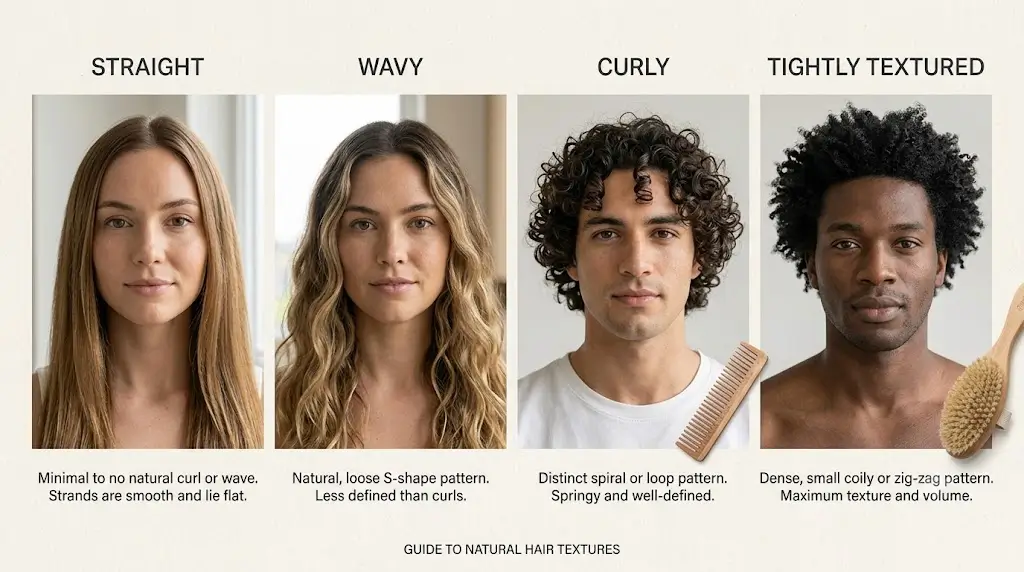
Straight Hair
Straight hair may allow natural scalp oils to travel down the hair shaft relatively easily. Some people with straight hair may therefore notice that their roots become oily sooner.
A lightweight routine and appropriate cleansing frequency may be more comfortable than repeatedly applying heavy products.
Wavy Hair
Wavy hair can sit between straight and curly textures. It may benefit from enough conditioning to manage dryness and frizz without using so much product that the waves become weighed down.
Curly Hair
Curly hair often needs careful handling because the bends and curves in the hair can make it more prone to dryness and tangling.
Gentle detangling, appropriate conditioning, and avoiding unnecessary manipulation can help make a curly hair routine easier to maintain.
Dry Hair
If your hair frequently feels dry, rough, or difficult to manage, your routine may need greater emphasis on conditioning and reducing habits that contribute to dryness.
You can also review your use of heat and chemical treatments if they are part of your regular routine.
If you have curls and want more texture-specific guidance, you can also explore our Hair Care Routine for Curly Hair.
💡 Reader Tip
Do not build your routine around the number of products you own. Build it around what your hair actually needs.
If three simple, consistent steps work well for you, there is no requirement to turn your routine into ten or fifteen steps.
That approach can also make your routine easier to maintain over time.
Match Your Routine to Your Scalp
Your hair care routine should not be based on hair texture alone. Your scalp also matters. A routine that works comfortably for an oily scalp may not feel right for a dry or easily irritated scalp.
The goal is to find a balance between keeping the scalp clean and avoiding unnecessary over-cleansing or irritation.
For a closer look at everyday scalp care, see our Healthy Scalp Care Guide for practical habits that can support a comfortable scalp-care routine.

Oily Scalp: Keep the Routine Light and Practical
If your scalp becomes oily quickly, you may prefer a cleansing schedule that matches how quickly oil builds up.
Instead of following a fixed rule such as washing on a particular day of the week, pay attention to your scalp.
Consider:
- How quickly your roots become oily
- Whether you exercise or sweat frequently
- How much styling product you use
- Whether your hair feels fresh and comfortable between washes
A lightweight conditioner can be useful for the lengths and ends without making the roots feel unnecessarily coated.
The key is consistency rather than trying to keep your scalp completely oil-free.
If your scalp tends to become oily quickly, our guide to a Hair Care Routine for Oily Hair provides more specific routine ideas.
Dry or Uncomfortable Scalp: Avoid Overcomplicating Your Routine
A dry-feeling scalp may need a gentler approach.
If frequent washing, very hot water, harsh-feeling products, or excessive styling seems to leave your scalp uncomfortable, review those habits rather than immediately adding multiple new products.
If the main concern is dry-feeling hair rather than the scalp itself, our guide to a Hair Care Routine for Dry Hair explores practical care habits in more detail.
You can try:
- Using comfortably warm rather than very hot water
- Being gentle when cleansing
- Avoiding unnecessary scratching
- Rinsing products thoroughly
- Limiting products that seem to cause discomfort
If scalp discomfort is persistent, severe, or accompanied by noticeable changes such as significant scaling, sores, or other concerning symptoms, it is better to seek advice from a qualified healthcare professional rather than trying to diagnose the cause yourself.
How Often Should You Wash Your Hair?
There is no single washing schedule that is right for everyone.
Your ideal routine may depend on:
Scalp oiliness + hair texture + activity level + styling habits + personal comfort
For example, someone with an oily scalp who exercises frequently may prefer more frequent cleansing, while someone with a drier-feeling scalp may find a different schedule more comfortable.
Rather than copying another person’s routine, observe how your scalp and hair respond.
A useful question to ask is:
“Does my current washing schedule leave my scalp comfortable and my hair manageable?”
If yes, there may be no reason to make frequent changes simply because another person follows a different routine.
Hair texture is only part of the picture, and Checking your hair porosity can offer another useful clue about how your strands respond to moisture.
Choose Products Based on Your Routine — Not Trends
A professional hair care routine does not require every product that appears in social media recommendations.
Start with the basics.
Shampoo
Choose a shampoo that fits your scalp and cleansing needs.
Conditioner
Choose a conditioner based on how your hair feels, particularly through the lengths and ends.
Leave-in or Styling Products
These are optional rather than mandatory. They may be useful when they solve a specific problem such as manageability, dryness, frizz, or styling.
Hair Treatments
Treatments can be considered when your hair has a particular need, but adding more products does not automatically create a better routine.
Simple and consistent often beats complicated and difficult to maintain.
Build a Routine You Can Actually Maintain
A routine can look good on paper but fail in real life if it takes too much time.
Instead, create a basic routine around the habits you can realistically maintain.
Your basic routine might include:
Cleanse → Condition → Detangle gently → Dry carefully → Style with minimal unnecessary stress
Then make small adjustments based on your hair type and scalp needs.
For example:
If your scalp is oily
Prioritize an appropriate cleansing routine and avoid unnecessarily heavy products around the roots.
If your hair is dry
Pay more attention to conditioning, gentle handling, and reducing avoidable heat or chemical stress.
If your hair is curly
Focus on gentle detangling, suitable conditioning, and reducing unnecessary manipulation.
If your hair is damaged
Prioritize gentle handling and consider reducing the habits that may be contributing to ongoing damage.
🌿 A Simple Rule for Product Changes
Do not change five products at once.
If you introduce several new products simultaneously and your hair responds differently, it becomes difficult to know what caused the change.
Instead, when practical, make one meaningful change at a time and observe how your hair responds.
This makes your routine easier to understand and easier to maintain.
Reader-Friendly Routine Checklist
Before you consider your routine complete, ask:
☐ Does my cleansing schedule suit my scalp?
☐ Am I conditioning the areas that need it?
☐ Am I detangling without unnecessary pulling?
☐ Am I limiting avoidable heat and chemical stress?
☐ Are my products appropriate for how my hair behaves?
☐ Is the routine simple enough for me to maintain?
☐ Am I changing products because I need them—or simply because they are trending?
If you can answer these questions comfortably, you already have a strong foundation.
🟢 Turn Your Routine Into a Simple Daily Habit
Once you understand your hair type and scalp needs, the next step is to make your routine easy enough to follow consistently.
A good routine does not need to look the same every morning and evening. Some steps are only needed on wash days, while others can become simple everyday habits.
If your individual strands are fine, our guide to a hair care routine for fine hair offers more specific tips for keeping your routine lightweight and manageable.
Morning Hair Care: Keep It Simple
Your morning routine can be quite short.
Depending on your hair type, you might:
- Gently arrange or detangle your hair.
- Use a suitable leave-in or styling product if you normally need one.
- Avoid excessive brushing or pulling.
- Choose a hairstyle that does not create unnecessary tension.
- Protect your hair from avoidable heat when styling.
If your hair already looks and feels manageable, there is no need to keep adding products.
The purpose of a morning routine is to manage your hair—not to overload it with products.
If your hair has low porosity, our guide to how to care for low porosity hair can help you build a routine around its moisture needs.
Evening Hair Care: Prepare Your Hair for the Night
An evening routine can focus more on gentle handling and preparation for sleep.
Before bed, consider:
- Gently detangling when appropriate for your hair texture
- Avoiding tight hairstyles that create unnecessary tension
- Removing styling accessories that may pull on the hair
- Making sure your hair is reasonably comfortable before sleeping
- Avoiding unnecessary heat styling late in the day
Your nighttime routine does not need to be complicated.
For some people, simply gentle handling + a comfortable hairstyle may be enough.
Your Routine Should Change When Your Hair Changes
Your hair does not necessarily stay the same throughout the year.
Changes in:
- weather
- humidity
- exercise
- styling habits
- colouring
- heat use
- hair length
- scalp condition
may affect how your hair feels and behaves.
For example, a routine that feels comfortable during a humid period may need small adjustments during a colder or drier season.
This does not mean you need to replace everything.
Make small changes only when your hair gives you a reason to do so.
Common Hair Care Routine Mistakes to Avoid
A good routine is not only about what you do. It is also about avoiding habits that may make hair care unnecessarily difficult.
1. Copying Someone Else’s Routine Exactly
A routine that works beautifully for one person’s curly hair or oily scalp may not suit someone with a different texture or scalp.
Use other people’s routines for ideas—not as strict instructions.
2. Using Too Many Products
More products do not automatically mean better hair care.
Too many products can make your routine expensive, difficult to maintain, or harder to understand.
3. Changing Products Too Frequently
If you change your shampoo, conditioner, treatment, oil, and styling products at the same time, it becomes difficult to understand what actually works for you.
Give your routine enough consistency to evaluate it sensibly.
4. Being Too Rough With Wet Hair
Hair can be more vulnerable to mechanical stress when wet. Gentle handling can therefore be preferable to vigorous rubbing, pulling, or aggressive detangling.
If frizz is one of your main concerns, our guide to a Hair Care Routine for Frizzy Hair offers more focused everyday care ideas.
5. Treating Hair and Scalp as Exactly the Same
Your scalp and hair lengths can have different needs.
For example, you may have an oilier scalp while your ends feel dry.
Your routine should account for both.
6. Following Trends Instead of Your Hair’s Needs
A viral product or technique may be popular, but popularity does not mean it is necessary for your routine.
Ask a simpler question:
“Does this actually solve something my hair needs?”
When Should You Reconsider Your Routine?
A routine does not have to be changed simply because you have been following it for a certain number of weeks.
Instead, review it when you notice a consistent change.
For example:
- Your scalp becomes noticeably oilier than usual.
- Your hair feels persistently dry or difficult to manage.
- Your routine becomes too complicated to maintain.
- A product repeatedly seems unsuitable for you.
- Your hair has been coloured or chemically treated.
- Your lifestyle or styling habits have changed.
When making changes, avoid changing everything simultaneously if you can.
Small, deliberate adjustments make it easier to understand what your hair actually responds to.
When Hair Care Needs More Than a Routine
A hair care routine can support everyday hair maintenance, but it cannot explain every scalp or hair concern.
If you notice persistent or significant hair loss, scalp pain, sores, severe or ongoing itching, marked scaling, or other unusual changes, consider discussing the issue with a qualified healthcare professional.
Likewise, if you are concerned about sudden or unexplained changes in your hair or scalp, professional assessment may be more appropriate than continually changing products at home.
This keeps the article helpful without presenting a routine as a treatment for an underlying medical condition.
If you have an ongoing hair or scalp concern, the American Academy of Dermatology Association provides dermatologist-reviewed information that can help you understand when professional care may be appropriate.
🌿 A Practical Example
Imagine someone has:
Oily scalp + dry-feeling ends + wavy hair
They do not necessarily need an “oily hair routine” or a “dry hair routine” copied exactly from somewhere else.
Instead, they could think about the needs separately:
Scalp: appropriate cleansing based on oiliness
Lengths: suitable conditioning for dryness
Texture: gentle handling to preserve waves
Styling: avoid unnecessary heavy products
Maintenance: adjust when hair or scalp needs change
This is the basic idea behind a hair care routine for your hair type:
Start with your actual needs, then build the simplest routine that addresses them.
🟢 Create a Routine You Can Keep
The best hair care routine is not necessarily the longest one. It is the one that fits your hair, scalp, lifestyle, and daily schedule well enough to follow consistently.
A simple routine can be built around a few questions:
Before washing
- Does my scalp feel oily, comfortable, or dry?
- Does my hair need cleansing today?
- Have I used styling products that need to be removed?
During washing
- Am I cleansing gently?
- Am I using a comfortable amount of product?
- Am I rinsing thoroughly?
After washing
- Does my hair need conditioning?
- Do I need a gentle detangling method?
- Can I reduce unnecessary heat or rough handling?
Between wash days
- Does my scalp still feel comfortable?
- Is my hair becoming dry, tangled, or difficult to manage?
- Do I really need another product, or would a simpler adjustment be enough?
This approach helps you build a routine around observation rather than rigid rules.
A Quick Hair-Type Routine Guide
| Hair or scalp need | Routine priority |
|---|---|
| Straight hair | Keep products manageable and adjust cleansing to scalp oiliness |
| Wavy hair | Balance conditioning with lightweight styling |
| Curly hair | Focus on gentle handling, conditioning, and detangling |
| Oily scalp | Choose a cleansing routine that suits your oil production |
| Dry-feeling hair | Prioritize conditioning and reduce avoidable damage |
| Frizzy hair | Focus on gentle handling and appropriate conditioning |
| Damaged hair | Reduce avoidable heat, chemical stress, and rough handling |
These are starting points, not strict rules. Your actual routine should be adjusted according to how your hair and scalp respond.
Frequently Asked Questions
How do I choose a hair care routine for my hair type?
Start by considering both your hair texture and scalp needs. Then build a simple routine around cleansing, conditioning, gentle handling, and styling habits that suit you.
How often should I wash my hair?
There is no universal schedule. Washing frequency can depend on scalp oiliness, hair texture, activity, styling habits, and personal comfort.
Should I use the same routine every day?
Not necessarily. Some steps may be daily habits, while cleansing and conditioning may happen according to your hair and scalp needs.
Is a longer hair care routine better?
Not automatically. A shorter routine that you can consistently maintain may be more useful than a complicated routine with unnecessary products.
Can my hair care routine change over time?
Yes. Weather, lifestyle, hair treatments, styling habits, hair length, and changes in scalp or hair condition can all affect what feels comfortable for you.
Should I copy a hair care routine I see online?
Use online routines as ideas rather than rules. Hair texture, scalp needs, lifestyle, and product preferences differ from person to person.
When should I seek professional advice about my hair or scalp?
If you experience persistent or significant hair loss, ongoing scalp discomfort, sores, marked scaling, severe itching, or other unusual changes, consider speaking with a qualified healthcare professional.
Final Takeaway
Building a hair care routine for your hair type does not have to be complicated.
Start by understanding your scalp and hair, then keep the basics consistent: cleanse appropriately, condition where needed, handle your hair gently, and reduce avoidable damage.
Most importantly, do not feel pressured to follow someone else’s routine exactly.
Your best routine is the one that meets your hair’s actual needs and is simple enough for you to maintain.
Conclusion
Hair care is not about finding one perfect routine that works forever. It is about understanding your own hair and making sensible adjustments when your needs change.
Start simple. Observe how your hair and scalp respond. Keep the habits that work well, reconsider the ones that do not, and avoid adding products simply because they are popular.
With a little consistency and attention, you can create a hair care routine that feels practical, manageable, and suited to you.