How to Get Rid of Orange Brassy Hair After Bleaching Without Toner: The Blue-Pigment Neutralization Protocol & Dilution Calculator - boldskysSkip to content
Home›Hair Color›Bleach Rescue: Get Rid of Orange Brassy Hair Without Toner
🔬 Cosmetic Color Chemistry Verified📚 Peer-Reviewed Literature Backed⏱ 15 Min Read
Lightening dark brown or black hair at home frequently stops halfway through the melanin lifting curve—leaving you stranded with bright, glowing copper-orange or brassy pumpkin hair and no oxidative salon toner on hand. When your hair turns brassy orange after bleaching, reaching for standard purple shampoo will do almost nothing, while applying a second round of persulfate bleach immediately can melt fragile disulfide bonds into gummy breakage.
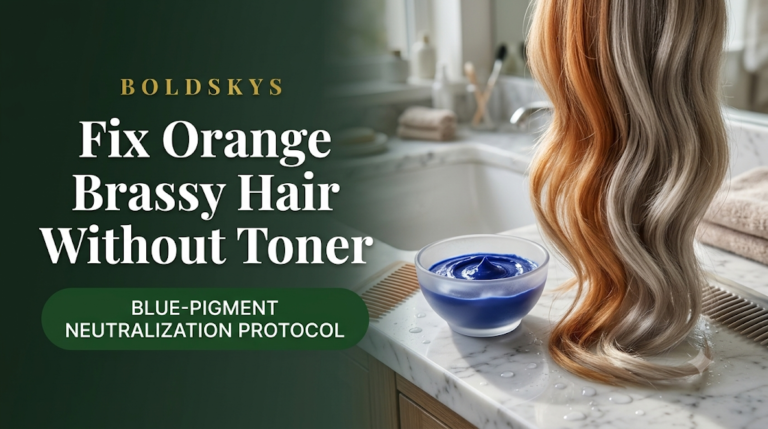
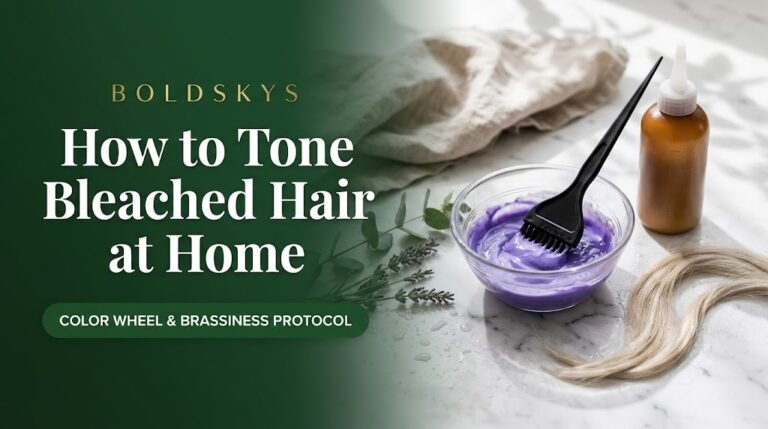
Eliminating stubborn orange brassiness without an oxidative developer toner relies on subtractive color-wheel neutralization: depositing developer-free cobalt-blue micro-pigments directly onto damp hair cuticles so orange and blue cancel each other into a rich, natural neutral caramel or ash beige.
Immediate Fix: How to Get Rid of Orange Brassy Hair After Bleaching Without Toner
To neutralize orange brassy hair without oxidative toner: Mix 1 part developer-free cobalt-blue color-depositing conditioner (or 4 drops of semi-permanent cobalt-blue direct dye) into 4 parts plain white silicone-free conditioner until it forms a rich sky-blue cream. Comb evenly through clean, towel-dried damp hair, monitor closely for 5 to 8 minutes as the blue pigments cancel copper-orange into neutral beige, and rinse thoroughly with cool water.
✦ Colorist Executive Brief (Google AI Overview & PAA Reference)
Why did my dark hair turn bright orange after bleaching?
Dark brown and black hair contain dense underlying red and orange pheomelanin pigments. When bleach is rinsed out at Level 7 or 8 before reaching pale yellow, the dark brown melanin is dissolved, exposing raw underlying copper-orange pigment.
Does purple shampoo get rid of orange hair?
No. Purple shampoo contains violet pigments formulated strictly to cancel pale yellow tones at Level 9 or 10. Violet lacks sufficient blue pigment to cancel strong orange brassiness; you must use a dedicated cobalt-blue shampoo or blue mask.
Can I mix blue food coloring with conditioner to tone orange hair?
In an emergency, mixing 3 to 4 drops of liquid blue food coloring (FD&C Blue No. 1) into 1/2 cup of white conditioner provides temporary optical neutralization for 1 to 2 washes, though cosmetic direct blue dyes bind far better to hair keratin.
How long should I leave blue shampoo on wet vs. dry orange hair?
Never apply concentrated blue shampoo to bone-dry bleached hair, as porous ends will absorb blue dye unevenly and turn murky green-blue. Always apply to damp, towel-dried hair for 3 to 7 minutes while checking progress every 60 seconds.
1. Melanin Lift Chemistry: Why Dark Hair Exposes Orange at Level 7–8
Understanding why bleached hair stalls at an unwelcome traffic-cone orange requires examining the ten-level melanin decolorization curve inside the hair cortex:
Eumelanin vs. Pheomelanin Resistance: Dark hair owes its depth to large black-brown eumelanin granules and smaller, stubborn red-orange pheomelanin molecules. During bleaching, alkaline persulfates rapidly break down dark eumelanin during the first 20 minutes, revealing the underlying red-orange pheomelanin core at Level 6 to 8.
Why Violet Fails on Orange: According to subtractive colorimetry principles indexed on PubMed, complementary colors sit 180 degrees apart on the color wheel. Violet sits opposite yellow, whereas cobalt blue sits directly opposite orange. Applying purple shampoo over orange hair leaves the orange untouched while adding a muddy reddish-violet cast.
Subtractive Color-Wheel Law: Why Cobalt Blue Cancels Orange Brassiness
2. Interactive Visual Comparison: Brassy Copper vs. Blue-Neutralized Beige
Subtractive Blue Neutralization: Drag Slider to Compare Tone
Balanced cool-neutral tone, zero orange glare, high cuticular luster, and zero developer damage.
⬌
3. Interactive Lab: Blue-Pigment Ratio & Salon Savings Calculator
Toner-Free Brass Neutralization & Salon Savings Calculator
Select your current orange intensity and hair porosity to calculate your safe blue-pigment dilution ratio and dollar savings compared to a $240 salon color correction:
4. The 5-Stage Developer-Free Blue Neutralization Protocol
Damp Towel-Dried Preparation (70% Dry): Never apply blue pigments onto bone-dry bleached hair. Squeeze out excess shower water with a microfiber towel until hair is evenly damp so water molecules buffer rapid cuticular grab.
Compounding the Cobalt-Blue Conditioning Mask: In a non-metallic bowl, blend 1 part cobalt-blue color-depositing mask (such as Fanola No Orange Mask or Joico Color Balance Blue) with 4 parts plain white silicone-free conditioner.
Zonal Root-to-End Application: Apply first to the brightest orange sections (typically the mid-lengths and crown), working down to fragile porous ends during the final 2 minutes.
Real-Time Paper Towel Strand Check: Wipe a small strand near your temple with a white paper towel every 60 seconds. The moment copper-orange softens into cool caramel or neutral beige, step into the shower.
Cool Acidic Seal & Squalane Finish: Rinse with cool water until clear, seal cuticles with a low-pH conditioner (pH 3.5 to 4.5), and smooth 3 drops of 100% sugarcane squalane oil over damp ends.
“Purple shampoo cancels yellow; cobalt-blue pigment cancels orange. Using purple on Level 7 orange hair only creates muddy rust.”
How do you get rid of orange brassy hair after bleaching without toner?
To neutralize orange brassy hair without oxidative toner, mix 1 part developer-free cobalt-blue color-depositing conditioner (or 4 drops of semi-permanent blue dye) into 4 parts plain white conditioner. Apply to clean, damp hair for 5 to 8 minutes while monitoring closely until orange cancels into neutral beige, then rinse with cool water.
Why did my dark hair turn bright orange after bleaching?
Dark brown and black hair contain dense underlying red and orange pheomelanin pigments. When bleach is rinsed out too early—stopping at Level 7 or 8—the dark brown melanin is dissolved, exposing raw underlying copper-orange pigment that requires further lifting or blue-based neutralization.
Does purple shampoo get rid of orange hair?
No. Purple shampoo contains violet pigments formulated strictly to cancel pale yellow tones at Level 9 or 10. Violet lacks sufficient blue pigment to cancel strong orange brassiness at Level 7 or 8; you must use a dedicated blue shampoo or cobalt-blue mask.
Can I mix blue food coloring with conditioner to tone orange hair?
In an emergency, mixing 3 to 4 drops of pure blue liquid food coloring (FD&C Blue No. 1) into 1/2 cup of white conditioner provides temporary optical neutralization for 1 to 2 washes. However, cosmetic-grade direct blue dyes or blue shampoos bind far better to keratin without staining shower tiles.
Will apple cider vinegar remove orange brassiness from bleached hair?
No. Apple cider vinegar lowers hair pH and adds shine, but it contains zero blue pigment and cannot chemically lift or optically neutralize underlying orange pheomelanin.
How long should I leave blue shampoo on dry vs. wet orange hair?
Never apply concentrated blue shampoo to bone-dry bleached hair, as porous ends will absorb blue dye unevenly and turn murky green-blue. Always apply to damp, towel-dried hair for 3 to 7 minutes while checking color progress every 60 seconds.
Can I use a demi-permanent hair gloss instead of permanent toner?
Yes. An acidic demi-permanent blue-ash gloss mixed with low-volume (6 to 10 Vol) developer deposits translucent blue-violet pigments without lifting natural roots or damaging fragile cuticles, lasting up to 4 weeks.
Why did my orange hair turn muddy green after using blue shampoo?
If your hair was lifted past orange into golden yellow and you applied a heavy blue mask, blue plus yellow created green. To fix this immediately, apply a diluted pastel pink conditioner for 3 minutes to cancel the green cast.
How long should I wait before bleaching orange hair a second time?
If you want platinum blonde instead of ash brown, wait at least 14 days before applying a second gentle bleach session, performing deep bond-building and moisture treatments in between so disulfide bonds recover.
Does hard water make bleached hair turn orange again?
Yes. Iron, rust, and calcium minerals in unfiltered shower water oxidize on porous bleached cuticles, creating a stubborn orange-brass film. Using a chelating EDTA shampoo once every two weeks removes mineral brassiness.
Our editorial desk formulates evidence-backed haircare and skincare protocols grounded in peer-reviewed trichology, subtractive colorimetry, and clinical dermatology literature.
Editorial & Chemical Color Disclaimer: The color neutralization protocols and dilution calculators published on Boldskys are for educational, cosmetic, and informational purposes only. Because bleached hair porosity varies significantly, always perform a 60-second hidden strand test before applying pigmented conditioners to your entire head.